Discuss Detection in Depth at CMH ISSA Summit


On May 18th, I will be presenting on detection in depth at the CMH ISSA Summit. I look forward to a good discussion of the ideals, organizational needs, and maturity models. Given all of the focus on re-allocating resources from “prevention only” strategies to an equal spread across the core values of prevention, detection and response, this is likely to be a useful discussion to many organizations.

Come ready with good questions. I will also be available throughout the Summit for break-out discussions, one-on-ones, and small team meetings. Please reach out via email, phone or Twitter to schedule a sit down. Otherwise, feel free to approach me in the halls and we can have an ad-hoc discussion if you want to learn more about specific detection in depth approaches.
 
I speak on Friday, May 18th at 11:15 am. I hope to see you there!

Information Security Is More Than Prevention


One of the biggest signs that an organization’s information security program is immature is when they have an obsessive focus on prevention and they equate it specifically with security.

The big signs of this issue are knee-jerk reactions to vulnerabilities, a never-ending set of emergency patching situations and continual fire-fighting mode of reactions to “incidents”. The security team (or usually the IT team) is overworked, under-communicates, is highly stressed, and lacks both resources and tools to adequately mature the process. Rarely does the security folks actually LIKE this environment, since it feeds their inner super hero complex.

However, time and time again, organizations that balance prevention efforts with rational detection and practiced, effective response programs perform better against today’s threats. Evidence from vendor reports like Verizon DBIR/Ponemon, law enforcement data, DHS studies, etc. have all supported that balanced program work much better. The current state of the threat easily demonstrates that you can’t prevent everything. Accidents and incidents do happen. 
 
When bad things do come knocking, no matter how much you have patched and scanned, it’s the preparation you have done that matters. It’s whether or not you have additional controls like enclaving in place. Do you have visibility at various layers for detection in depth? Does your team know how to investigate, isolate and mitigate the threats? Will they do so in a timely manner that reduces the impact of the attacker or will they panic, knee-jerk their way through the process, often stumbling and leaving behind footholds of the attacker?
 
How you perform in the future is largely up to you and your team. Raise your vision, embrace a balanced approach to security and step back from fighting fires. It’s a much nicer view from here. 

The Detection in Depth Focus Model & Example

Furthering the discussion on how detection in depth works, here is an example that folks have been asking me to demonstrate. This is a diagram that shows an asset, in this case PII in a database that is accessed via a PHP web application. The diagram shows the various controls around detection in place to protect the data at the various focus levels for detection. As explained in the maturity model post before, the closer the detection control is to the asset, the higher the signal to noise ratio it should be and the higher the relevance o the data should be to the asset being protected (Huston’s Postulate). 

Hopefully, this diagram helps folks see a working example of how detection in depth can be done and why it is not only important, but increasingly needed if we are going to turn the tide on cyber-crime.
 
As always, thanks for reading and feel free to engage with ideas in comments or seek me out on Twitter (@lbhuston) and let me know what you think. 

Detection in Depth Maturity Model

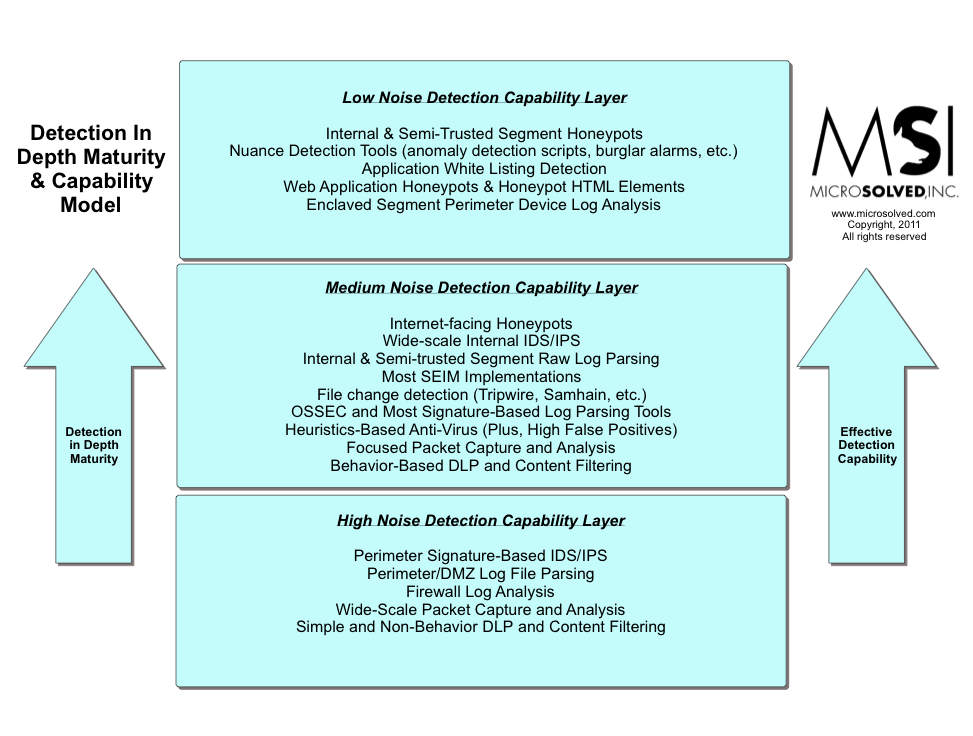
I have been discussing the idea of doing detection depth pretty heavily lately. One of the biggest questions I have been getting is about maturity of detection efforts and the effectiveness of various types of controls. Here is a quick diagram I have created to help discuss the various tools and where they fit into the framework of detection capability versus maturity/effectiveness.

The simple truth is this, the higher the signal to noise ratio a detection initiative has, the better the chance of catching the bad event. Detections layered together into various spots work better than single layer controls. In most cases, the closer you get to an asset, the more nuanced and focus (also higher signal to noise ratio) the detection mechanisms should become.
 
That is, for example – a tool like a script detecting new files with “base64decode()” in them on a web server is much higher signal than a generic IDS at the perimeter capturing packets and parsing them against heuristics.
 
When the close controls fire an alert, there better be a clear and present danger. When the distant controls alert, there is likely to be more and more noise as the controls gain distance from the asset. Technology, detection focus and configuration also matter A LOT. 
All of that said, detection only works if you can actually DO something with the data. Alarms that fire and nothing happens are pretty much useless tools. Response is what makes detection in depth a worthwhile, and necessary, investment.