The Evidence Supply Chain: How CISOs Build a Cyber Materiality Data Plane Before the Incident

A ransomware incident does not wait for the organization chart to catch up.

At 8:17 a.m., the SOC sees encryption activity on a file server. At 8:31, operations says the plant is still running. At 8:44, finance says revenue recognition may be affected if order processing stays down past noon. At 9:02, legal asks whether customer data was accessed. At 9:18, the forensic team says it is too early to tell. At 9:23, a vendor says the outage may have started in their environment. At 9:41, communications asks whether they should prepare a holding statement.

By hour two, everyone is working hard.

But they are not necessarily working from the same reality.

That is the problem.

Cyber materiality is often discussed as a decision problem. When does a cyber event become a board-level business event? When does it become reportable? When does it become material to investors, customers, regulators, lenders, or strategic partners?

Those are important questions. Public companies, for example, must disclose material cybersecurity incidents on Form 8-K within four business days after determining materiality, including the material aspects of the incident’s nature, scope, timing, and impact or reasonably likely impact. 

But underneath that decision sits a deeper problem:

Can the organization produce trustworthy evidence quickly enough to support the decision?

That is not a legal question alone. It is not a forensics question alone. It is not a finance question alone. It is an architecture question.

The mature CISO, GC, CFO, and board risk committee should be thinking about the evidence supply chain long before the incident happens.

A woman standing in a room lit by bright fluorescent lights surrounded by whiteboards and sticky notes filled with ideas sketching out concepts and plans 5728491

Materiality Fails When Evidence Fails

In many organizations, the materiality process looks organized on paper.

There is an incident response plan. There is an escalation matrix. There is a crisis management team. There are outside counsel contacts, cyber insurance contacts, forensic retainers, PR templates, and board notification procedures.

That is all useful.

But when the event happens, the decision process often degrades because the evidence environment is weak.

Logs are incomplete. Asset ownership is unclear. Business process dependencies are tribal knowledge. Finance does not know how to translate system downtime into business impact. Legal receives facts that have already been filtered through three layers of operational optimism. Operations reports “no impact” because the line is still running, while customer support is seeing a spike in failed transactions. The cloud team has telemetry, but no one knows whether the affected SaaS platform stores regulated data. The vendor management team has a contract, but not a current data flow map.

That is how materiality decisions become arguments.

Not because people are incompetent.

Because the organization has not engineered the evidence supply chain.

The SEC’s rules have forced public companies to become more explicit about material cyber incidents, but the operational challenge is broader than the SEC. The same issue appears in customer notification, contractual reporting, cyber insurance claims, regulatory inquiries, litigation holds, board oversight, lender communications, and M&A diligence. The evidence has to be timely, traceable, and business-relevant.

NIST CSF 2.0 is useful here because it elevated “Govern” as a core function. That matters. Governance is not just committee structure. It is the ability to understand, assess, prioritize, and communicate cybersecurity risk in business terms. 

For cyber materiality, governance lives or dies on evidence.

The Evidence Supply Chain

I like the phrase “evidence supply chain” because it forces us to think in systems.

Evidence does not magically appear in the war room. It is produced, transformed, transported, interpreted, challenged, and consumed.

A firewall log becomes a timeline.

A timeline becomes a scope estimate.

A scope estimate becomes a business impact hypothesis.

A business impact hypothesis becomes a legal and executive decision.

At each handoff, there is risk.

Data can be stale. Context can be missing. Confidence can be overstated. Contradictions can be suppressed. Assumptions can harden into “facts” because someone put them in a slide deck.

That is dangerous.

A cyber materiality data plane should answer five questions:

  1. Where did this evidence come from?
  2. Who owns it?
  3. How fresh is it?
  4. How confident are we in it?
  5. What would change our mind?

Those questions sound simple. In a live incident, they are not.

Evidence Provenance: Know the Source Before You Trust the Story

The first discipline is provenance.

In incident response, people often ask, “What do we know?”

A better question is, “What do we know, from what source, as of what time, with what confidence?”

There is a big difference between these two statements:

“No customer data was accessed.”

And:

“As of 10:15 a.m., based on EDR telemetry from 84% of managed endpoints and current cloud access logs, we have not observed evidence of customer data access. Logging gaps remain in two legacy systems and one vendor-managed repository.”

The second statement is less comforting.

It is also far more useful.

Provenance prevents false certainty. It tells the board and executives not only what is known, but how it is known. It also makes visible the places where evidence is missing.

CISOs should build provenance into the process before the incident. For the systems that matter most, define the authoritative evidence sources in advance:

  • Endpoint telemetry
  • Identity logs
  • Cloud activity logs
  • SaaS audit logs
  • Network flow data
  • Backup integrity reports
  • Data classification repositories
  • Asset inventories
  • Vendor attestations
  • Financial impact models
  • Customer and operational impact signals

Then identify the weaknesses.

Which logs are retained for only seven days? Which SaaS platforms have audit logging disabled or licensed only at a premium tier? Which critical business applications are vendor-managed? Which systems lack reliable asset ownership? Which data stores have uncertain classification?

Those are not just technical gaps.

They are future materiality gaps.

Confidence Scoring: Stop Treating All Facts as Equal

Every incident has facts, assumptions, estimates, and guesses.

The problem is that once they enter an executive update, they often look the same.

That is how leadership teams get into trouble. A forensic observation with strong evidence sits next to a business unit estimate based on a phone call. A CFO model based on actual transaction loss sits next to a vendor statement that has not been independently validated. A legal conclusion may depend on a technical fact that is still only moderately supported.

The evidence supply chain should score confidence explicitly.

A simple model is enough to start:

  • High confidence: Direct evidence from authoritative systems, validated by an owner, current, and independently corroborated.
  • Medium confidence: Evidence from a plausible source, partially validated, with some gaps or unresolved assumptions.
  • Low confidence: Anecdotal, stale, vendor-provided without validation, inferred from incomplete telemetry, or dependent on untested assumptions.
  • Unknown: Evidence required for the decision does not yet exist or has not yet been collected.

This changes the conversation.

Instead of saying, “The outage is not material,” the team can say:

“Current confidence in non-material operational impact is medium. Financial impact is low confidence because order backlog and customer churn exposure have not yet been modeled. Data exposure remains unknown for the vendor-hosted document repository.”

That is not weakness.

That is governance.

Contradiction Handling: Build a Place for Disagreement

In the first few hours of a serious cyber event, contradictory facts are normal.

Forensics may say there is evidence of lateral movement.

The application owner may say the application was not affected.

Finance may say revenue impact is minimal.

Customer support may say call volume is tripling.

The vendor may say their environment is clean.

Your logs may show vendor credentials being used at strange hours.

The worst thing an organization can do is smooth those contradictions away too early.

Contradiction is signal.

A cyber materiality data plane should include a contradiction register. That can be as simple as a maintained table during the incident:

  • Claim A
  • Claim B
  • Evidence supporting each claim
  • Owner responsible for resolution
  • Confidence level
  • Decision relevance
  • Deadline for update

For example:

Contradiction Why It Matters Owner Decision Relevance
Vendor says no breach; identity logs show suspicious vendor account use May affect scope, contractual notice, and third-party disclosure Vendor risk + IR lead High
Operations reports no production impact; finance sees delayed shipments May affect revenue and customer commitments COO + CFO delegate High
No confirmed data exfiltration; DLP logs unavailable for affected repository May affect legal notification and materiality Legal + cloud owner High

The goal is not to force consensus.

The goal is to keep uncertainty visible long enough for the organization to make better decisions.

Decision Thresholds: Pre-Wire the Escalation Logic

Materiality is ultimately a judgment call. But that does not mean every incident should start from scratch.

Before the incident, leadership should define escalation thresholds that connect evidence to decision forums.

Examples might include:

  • Confirmed or likely disruption of a revenue-generating process
  • Loss of availability for a critical system beyond a defined time window
  • Evidence of unauthorized access to regulated, confidential, or strategically sensitive data
  • Material vendor dependency failure
  • Impact to financial reporting systems
  • Operational disruption that may affect customer commitments
  • Reasonably likely reputational, legal, or regulatory consequences
  • Uncertainty above a defined level for a defined period of time

That last one matters.

Sometimes the trigger is not confirmed impact. Sometimes the trigger is unresolved uncertainty about potential impact.

This is where many organizations get uncomfortable. They want certainty before escalation. But the materiality clock does not care whether your evidence pipeline is mature. SEC staff has also encouraged companies to use different Form 8-K items for voluntary disclosure of incidents that are not yet determined to be material or that are determined to be immaterial, which reinforces the need to separate the disclosure decision from general communications pressure. 

The board risk committee does not need every packet capture.

It does need to know when uncertainty itself has become a governance issue.

Board-Ready Narratives: Evidence Is Not Enough

A pile of evidence is not a board narrative.

The board needs a clear explanation of what happened, what is known, what is unknown, what is being done, what decisions are required, and what could change the conclusion.

A good board-ready cyber materiality narrative has five parts:

1. Event summary

What happened, when it was detected, and what business services may be affected.

2. Current evidence posture

What evidence sources have been reviewed, which are pending, and where gaps exist.

3. Business impact analysis

Operational, financial, legal, customer, regulatory, and reputational dimensions.

4. Confidence and contradictions

What the team believes, how strongly it believes it, and what facts conflict.

5. Decision recommendation

Whether to escalate, notify, disclose, continue monitoring, seek outside validation, or convene additional governance bodies.

The key is to avoid both panic and minimization.

The board does not need drama. It needs decision-quality evidence.

Implementation: Building the Evidence Map

The first practical step is to build an evidence map.

Pick the top business services that would matter most in a cyber incident. Not the top servers. Not the top applications. The top business services.

For each service, map:

  • Business owner
  • Technical owner
  • Data owner
  • Legal/regulatory owner
  • Primary systems
  • Critical vendors
  • Data types processed
  • Revenue or operational dependency
  • Key telemetry sources
  • Evidence gaps
  • Manual workarounds
  • Financial impact model
  • Customer impact signals

This exercise is usually humbling.

Most organizations discover that their most important services depend on systems they do not fully monitor, vendors they do not fully understand, or data stores that are not cleanly classified.

That is the point.

You do not want to discover those gaps in hour two of a ransomware event.

Assign Evidence Owners

During incidents, people often confuse system ownership with evidence ownership.

They are not the same.

An application owner may understand the business function but not the logs. A SOC analyst may understand the alert but not the revenue dependency. A vendor manager may have the contract but not the technical telemetry. A finance leader may know the revenue exposure but not the operational workaround.

Evidence ownership should be explicit.

For each critical evidence type, assign an owner responsible for producing, validating, and explaining it under incident conditions.

Examples:

Evidence Type Owner
Endpoint compromise scope IR lead / SOC manager
Identity abuse evidence IAM owner
SaaS access logs SaaS platform owner
Customer data exposure Data owner + legal
Revenue impact Finance delegate
Operational downtime Business process owner
Vendor assertions Third-party risk owner
Backup recoverability Infrastructure owner
Communications risk Legal + communications

This is where tabletop exercises become valuable. CISA’s ransomware guidance emphasizes having an incident response plan and communications plan that are maintained and exercised in advance. The same principle should apply to evidence production.

Do not just rehearse who talks.

Rehearse who proves.

Define Minimum Evidence Packets

A minimum evidence packet is the smallest set of information required to support a specific escalation or decision.

For a ransomware event affecting order processing, the minimum packet might include:

  • Affected systems and business services
  • Current availability status
  • Known blast radius
  • Evidence of data access or exfiltration
  • Backup status and restoration estimate
  • Revenue impact estimate
  • Customer impact estimate
  • Contractual or regulatory notification triggers
  • Confidence score
  • Open contradictions
  • Next evidence update time

For a vendor breach, it might include:

  • Vendor service affected
  • Data shared with vendor
  • Contractual notification obligations
  • Vendor’s stated timeline
  • Independent telemetry from your environment
  • Customer or operational dependency
  • Alternative service options
  • Confidence in vendor assertions
  • Legal and communications posture

The minimum evidence packet prevents the war room from becoming a scavenger hunt.

It also prevents executive updates from becoming collections of whatever facts were easiest to obtain.

Rehearse Contradictory-Fact Scenarios

Most tabletops are too clean.

The malware is detected. The team escalates. The business impact is known. Legal makes a call. Communications drafts a statement. The board is briefed.

Real incidents are messier.

A better tabletop injects contradictions:

  • The vendor says no customer data was accessed, but your logs are incomplete.
  • The COO says operations are normal, but finance reports delayed orders.
  • The forensic firm says there is no evidence of exfiltration, but the threat actor posts a sample file.
  • The SaaS provider says only metadata was exposed, but the contract defines metadata as confidential information.
  • The business says the workaround is fine, but customer support tickets are accelerating.
  • The model says the financial impact is below threshold, but the incident affects a strategically important customer segment.

This kind of exercise tests the evidence supply chain, not just the incident response plan.

That is where the real learning happens.

A Bayesian View of Materiality Confidence

Security leaders do not need to become statisticians to use Bayesian thinking.

They just need to get comfortable updating beliefs as evidence changes.

At the beginning of an incident, the organization has a prior belief: based on the type of event, affected systems, threat actor behavior, and business dependency, how likely is this to become a material event?

As evidence arrives, the organization updates that belief.

For example:

  • Initial ransomware on isolated endpoint: low prior probability of materiality
  • Evidence of domain admin compromise: probability increases
  • Critical ERP unavailable: probability increases again
  • Backups validated and restoration underway: probability decreases
  • Threat actor claims data theft: probability increases
  • No evidence of exfiltration, but logging gaps remain: probability remains uncertain
  • Finance estimates revenue impact below threshold: probability decreases
  • Customer churn risk emerges in strategic segment: probability increases

The important thing is not the exact math. The important thing is the discipline.

A Bayesian materiality model forces leaders to ask:

  • What did we believe before this evidence?
  • How reliable is the new evidence?
  • How much should this evidence change our belief?
  • What evidence would change our conclusion?
  • What uncertainty remains?

A simple scoring model might track probability bands:

Probability Band Meaning Governance Action
0–20% Unlikely material based on current evidence Monitor; routine executive updates
21–50% Plausible materiality depending on unresolved facts Convene cross-functional review
51–75% More likely than not to require board-level attention Prepare board briefing and disclosure analysis
76–100% Strong evidence of material or reasonably likely material impact Escalate immediately; execute disclosure and communications process

This is not a replacement for legal judgment.

It is a way to make the judgment traceable.

The real value is not precision. It is transparency.

Real-World Pattern: SaaS Outage

Consider a major SaaS platform used for customer support.

The platform goes down due to a suspected cyber incident at the provider. Internally, no systems are compromised. The security team initially classifies the event as a third-party issue.

But the business impact may still be significant.

Customer response times degrade. Service-level commitments may be missed. Contractual penalties may apply. High-value customers may escalate. If the outage affects a regulated service, the organization may have downstream obligations even though the incident began elsewhere.

The evidence supply chain has to connect vendor facts to business impact.

The key evidence is not only, “Was our data breached?”

It is also, “Can we serve customers, meet obligations, and sustain revenue?”

Real-World Pattern: Vendor Breach

Now consider a vendor breach involving a file transfer platform.

The vendor says your tenant was not affected. Your own logs are limited because the platform is externally hosted. The procurement team has the contract, but the security team does not have the data inventory. Legal asks whether regulated data was present. The business owner says the platform was used “mostly for internal files.”

Mostly is not evidence.

The minimum evidence packet should include the data types exchanged, tenant access logs, vendor incident timeline, contractual notice requirements, compensating telemetry, and confidence in the vendor’s assertions.

The contradiction register should explicitly track any gap between vendor statements and internal evidence.

Trust the vendor relationship.

Verify the evidence.

Real-World Pattern: AI Data Leakage Ambiguity

AI introduces a new class of evidence problems.

An employee pastes sensitive source code into an unsanctioned AI tool. A business unit uses an AI assistant connected to internal documents. A vendor adds AI features to a platform that already processes customer data. A prompt log contains confidential information, but the provider’s retention and training policies are unclear.

Was there a breach?

Was there unauthorized access?

Was confidential data exposed?

Was the data used for training?

Can it be retrieved, deleted, or isolated?

The technical facts may be murky. The legal interpretation may depend on contracts, privacy terms, jurisdiction, and data type. The business impact may depend on whether the information was strategic, regulated, customer-provided, or competitively sensitive.

This is exactly where evidence provenance and confidence scoring matter.

AI incidents will often start as ambiguity, not certainty.

The organization that can map evidence quickly will make better decisions than the one that argues from instinct.

The 30-Day Evidence Supply Chain Assessment

A CISO does not need a year-long transformation program to begin.

Start with 30 days.

Week 1: Identify the top five materiality-relevant business services.

Do not boil the ocean. Pick the services whose disruption, compromise, or data exposure would create the most serious business concern.

Week 2: Build evidence maps for those services.

Map owners, systems, vendors, data types, telemetry, financial dependencies, legal triggers, and evidence gaps.

Week 3: Define minimum evidence packets.

For ransomware, vendor breach, SaaS outage, data exposure, and AI leakage scenarios, define the minimum evidence required for executive and board-level decisions.

Week 4: Run a contradictory-fact tabletop.

Do not test whether people know the incident response plan. Test whether the organization can produce decision-quality evidence under pressure.

At the end of 30 days, the organization should be able to answer:

  • Which evidence matters most?
  • Who owns it?
  • How fast can we produce it?
  • Where is confidence weak?
  • Which contradictions are most likely?
  • Which evidence gaps could impair a materiality decision?

That is a practical outcome.

It is also a governance outcome.

Final Thought

Cyber materiality is not just about deciding when an incident matters.

It is about building the machinery that allows the organization to know what matters, how much it matters, and how confident it is in that judgment.

That machinery is the evidence supply chain.

The best time to build it is before the ransomware note, before the vendor email, before the SaaS outage, before the AI data leak, before the board asks the question everyone fears:

“How do we know?”

The organizations that can answer that question clearly will make better decisions under pressure.

The ones that cannot will still make decisions.

They will just be making them in the fog.

More Information and Help

If your organization is working through these questions, MicroSolved, Inc. can help.

MSI works with leadership teams, security teams, legal stakeholders, and risk committees to turn cyber risk from a collection of disconnected technical signals into decision-ready business evidence. We help organizations assess their current evidence supply chain, identify the gaps that would matter most during a cyber incident, and build practical, defensible processes for escalation, board reporting, and materiality support.

Our team can assist with:

  • Cyber materiality evidence supply-chain assessments
  • Incident response and ransomware readiness reviews
  • Executive and board-level tabletop exercises
  • Evidence mapping for critical business services
  • Third-party and SaaS incident escalation planning
  • Cyber risk governance program development
  • Security program assessments and advisory support

The goal is simple: when something goes wrong, your organization should not be scrambling to determine what evidence exists, who owns it, or whether leadership can trust it. Those answers should be engineered before the incident.

For more information, or to discuss how MicroSolved can help your organization strengthen its cyber evidence supply chain, contact us at:

MicroSolved, Inc.
Website: https://microsolved.com
Email: info@microsolved.com
Phone: +1.614.351.1237


* AI tools were used as a research assistant for this content, but human moderation and writing are also included. The included images are AI-generated.

Cyber Materiality Engineering: How CISOs Pre-Decide When Risk Becomes a Board Event

A ransomware incident does not stay technical for very long.

For about the first fifteen minutes, it may look like a security operations problem. A strange alert. A locked server. A suspicious authentication chain. A vendor portal behaving badly. A handful of systems no longer responding the way they should.

Then the blast radius starts to widen.

Operations wants to know whether they can keep running. Finance wants to know whether revenue recognition, cash movement, reserves, or forecasts are exposed. Legal wants to know whether notification clocks have started. The CEO wants to know what can be said, to whom, and when. The board wants to know whether this is “material.” Investors may eventually ask the same thing, only with less patience and more lawyers.

This is where many organizations discover that their cyber incident response plan is not really an enterprise decision plan. It tells people who to call. It tells the SOC how to preserve evidence. It may even have a communications tree and a sample press statement.

But it often does not answer the question that matters most in the first few hours:

At what point does a cyber event become a board-level business event?

That decision should not be invented under pressure.

The SEC’s public-company cybersecurity disclosure rules, adopted in 2023, require disclosure of material cybersecurity incidents and periodic disclosure about cybersecurity risk management, strategy, and governance. The SEC’s own small business compliance guide summarizes the rule as having two major components: incident disclosure and annual disclosures about cyber risk management and governance. 

That does not mean every cyber event is material. It does mean that mature organizations need a defensible way to decide, before the incident happens, how they will evaluate materiality when the facts are incomplete, emotions are high, and the clock is moving.

That is what I mean by cyber materiality engineering.

Not compliance theater. Not a prettier incident response binder. Not another “compliance is not security” lecture.

Cyber materiality engineering is the deliberate design of decision architecture around the point where cyber risk becomes enterprise risk.

A man with glasses performing an audit with careful attention to detail with an office background cinematic 8K high definition photograph


The Problem: Materiality Is Usually Decided at the Worst Possible Time

Most organizations make materiality decisions in the middle of uncertainty.

That is understandable. Incidents are messy. Early facts are often wrong. Initial impact estimates are incomplete. Forensics may lag behind business reality. Threat actors lie. Vendors understate. Internal teams overcorrect. Executives want certainty before making commitments, but certainty is usually not available when the most important decisions must be made.

The result is predictable.

The CISO is asked, “Is this bad?”

Legal asks, “Is this reportable?”

Finance asks, “How much will this cost?”

The board asks, “Why are we just now hearing about this?”

The security team may answer technically: number of systems affected, indicators of compromise, malware family, containment status, suspected access path.

Those answers matter. But they do not, by themselves, answer the enterprise question.

A materiality decision is not simply a severity rating. It is not the same thing as “critical” in the ticketing system. It is not the same thing as whether data was definitely exfiltrated. It is not even limited to direct financial loss.

A cyber incident may be material because it disrupts operations, threatens liquidity, harms customers, triggers contractual obligations, changes risk assumptions, undermines confidence in management, or creates a reasonable likelihood of financial, legal, or reputational consequences that matter to investors, members, customers, regulators, or other stakeholders.

That is why the decision cannot live inside security alone.

The CISO may own much of the evidence. The GC may own the disclosure and privilege strategy. The CFO may own the financial impact model. The CEO may own external accountability. The board owns oversight.

But the organization owns the decision.

When that decision model is vague, the organization tends to fall into one of two bad patterns.

The first is under-escalation. Everyone waits for perfect evidence. Nobody wants to alarm the board. The incident is treated as a technical matter until it suddenly becomes a legal, financial, or reputational crisis. By then, the company is explaining not only the incident, but also the delay.

The second is over-escalation without structure. Every ambiguous event becomes an executive fire drill. The board gets noise instead of judgment. Teams burn cycles producing speculative updates. Decision-makers become fatigued. Eventually, real signals are missed because everything has been treated like an emergency.

Both are governance failures.

The right answer is not “escalate everything.” The right answer is to engineer a decision system that can operate under uncertainty.


A Five-Part Cyber Materiality Model

A useful cyber materiality model should be simple enough to use during an incident and robust enough to defend after one.

I like a five-part model:

  1. Operational impact
  2. Financial exposure
  3. Customer or member harm
  4. Regulatory, legal, or contractual trigger
  5. Evidence confidence

The first four describe impact. The fifth describes how sure we are.

That distinction matters. A low-confidence, high-impact scenario may deserve board escalation even before the facts are complete. A high-confidence, low-impact event may not. A mature process separates what we know, what we suspect, what we can prove, and what could reasonably become true as the investigation unfolds.

1. Operational Impact

Start with the business.

What critical service, product, process, facility, workflow, or revenue engine is impaired?

Security teams often think in systems. Boards think in business functions. The bridge between the two is operational impact.

A domain controller outage is not material because it is a domain controller. It becomes material when it prevents loan processing, stops manufacturing, interrupts clinical operations, halts order fulfillment, delays payroll, or takes down a customer-facing platform.

The pre-incident work is to map technical dependencies to business services before the crisis.

That means knowing which systems support revenue, which systems support safety, which systems support regulated processes, which systems support customers, and which systems create cascading failure if they are unavailable.

This is where many business impact analyses fall short. They exist as disaster recovery paperwork, not as live decision tools.

For materiality engineering, the question is not merely, “What is the recovery time objective?”

The better question is:

If this function is impaired for 4, 12, 24, or 72 hours, who outside IT will care, and why?

2. Financial Exposure

Next comes financial exposure.

This includes direct loss, but it should not stop there. A real financial model should consider response costs, lost revenue, fraud losses, contractual penalties, customer credits, legal fees, regulatory exposure, insurance retention, increased borrowing pressure, delayed transactions, impairment of assets, and potential impact to forecasts.

CFOs are especially important here because security leaders may not know which financial thresholds matter inside the company.

A $500,000 incident may be noise in one organization and existential in another. A two-day outage may be tolerable in one business model and catastrophic in another. A fraud event that looks small in gross dollars may become material if it exposes a control weakness in a high-trust environment.

Pre-deciding thresholds does not mean creating a magic number where everything above it is material and everything below it is not. That is too simplistic.

It means defining ranges that guide escalation:

  • Known or estimated loss
  • Reasonable worst-case exposure
  • Confidence in the estimate
  • Impact to forecast, liquidity, covenants, or reserves
  • Whether the exposure is isolated or systemic

The number matters. The story behind the number matters more.

3. Customer, Member, or Patient Harm

Cybersecurity is often discussed as if the primary victim is the company.

Sometimes that is true. Often it is not.

Customers may lose access to services. Members may experience account fraud. Patients may experience care disruption. Employees may have sensitive personal information exposed. Business partners may inherit risk through integrations. In a SaaS environment, one tenant’s compromise may raise questions about other tenants, even when segmentation worked exactly as designed.

Customer harm is not just a public relations category. It is a materiality input.

The board does not only need to know whether data left the building. It needs to know whether stakeholders were harmed, whether they could be harmed, whether the organization can identify who was affected, and whether the organization has a credible plan to reduce further harm.

A mature materiality playbook should define harm categories in advance:

  • Loss of access
  • Loss of funds
  • Exposure of sensitive data
  • Business interruption for customers
  • Safety or health implications
  • Loss of trust in a core service
  • Downstream impact to dependent organizations

This is especially important for financial institutions, healthcare, SaaS providers, managed service providers, and any organization whose customers rely on it for critical operations.

The question is not only, “Did we get breached?”

The better question is:

Who else is now carrying risk because of what happened to us?

4. Regulatory, Legal, and Contractual Triggers

Cyber events do not happen in a vacuum.

They intersect with privacy laws, sector regulators, customer contracts, cyber insurance policies, law enforcement considerations, public disclosure obligations, banking rules, vendor commitments, litigation holds, and sometimes national security reporting expectations.

The SEC rules are one example for public companies, but they are not the only driver. The SEC final rule requires registrants to disclose material cybersecurity incidents on Form 8-K and also requires annual disclosures related to cybersecurity risk management, strategy, and governance. FINRA has also summarized the SEC rule as requiring disclosure of material cybersecurity incidents and periodic disclosure about cyber risk management, strategy, and governance. 

Private companies should still pay attention. They may not have the same public-company filing obligations, but they often face customer, lender, insurer, regulator, or board expectations that look very similar in practice.

This is where the GC’s office earns its seat in the process.

The pre-incident materiality model should identify which triggers matter by jurisdiction, industry, contract type, data type, customer segment, and regulator. It should also define who has authority to interpret those triggers during an incident.

A common failure mode is to treat regulatory analysis as something that begins only after forensics has reached a conclusion.

That is too late.

Legal analysis should start when facts suggest a reasonable possibility that a trigger may exist. That does not mean making premature disclosures. It means preserving options, protecting privilege where appropriate, collecting the right evidence, and preventing casual internal statements from becoming tomorrow’s exhibit.

5. Evidence Confidence

Finally, and most importantly, the model must account for confidence.

This is the part many materiality discussions miss.

Early incident facts are probabilistic. We may know that an account was compromised, but not whether data was accessed. We may know that ransomware executed, but not whether backups are clean. We may know that a vendor was breached, but not whether our environment or data was touched. We may know that a model ingested sensitive data, but not whether that data was retained, exposed, or used inappropriately.

A decision model that requires certainty will fail.

Instead, materiality engineering should define evidence confidence levels:

  • Confirmed: supported by logs, forensic evidence, business records, or direct observation.
  • Probable: strongly indicated by multiple credible signals, but not fully proven.
  • Plausible: possible based on known facts, threat behavior, or exposure path.
  • Speculative: not supported yet, but raised as a scenario to monitor.

This allows the organization to say something much more useful than “we do not know yet.”

It can say:

“We have a plausible but unconfirmed path to customer data exposure. Operational impact is low. Regulatory impact may be high if confirmed. Confidence is currently moderate on access and low on exfiltration. We recommend escalating to the disclosure committee and briefing the board risk chair within the next update cycle.”

That is governance.


Implementation: Build the Decision Tree Before the Incident

A materiality model is only useful if it becomes operational.

That means building a pre-incident decision tree that connects facts to actions.

The decision tree should not try to predict every scenario. It should define how the organization moves from signal to severity, from severity to escalation, and from escalation to board-level decision.

At a minimum, it should answer these questions:

Who can convene the materiality group?
This should not require a committee meeting to schedule a committee meeting. The CISO, GC, CFO, CEO, or incident commander should have clear authority to trigger the process.

Who is in the materiality group?
Typically: CISO, GC, CFO, CIO or CTO, privacy leader, communications, business owner, risk leader, and incident commander. For some organizations, internal audit, compliance, investor relations, HR, or vendor management may also be necessary.

Who makes the recommendation?
The group should produce a recommendation, but the decision rights must be clear. Is the decision made by the CEO? Disclosure committee? GC and CFO jointly? Board committee? Define this before the incident.

What evidence is required for each decision?
Do not wait until the incident to decide what “enough evidence” means. Define minimum evidence packages for operational impact, financial exposure, customer harm, legal triggers, and confidence.

When is the board notified?
There should be multiple board escalation levels. Not every incident requires a full board meeting. Some require notice to the board risk chair. Some require briefing the audit committee. Some require a formal board call. Some require ongoing updates.

What gets documented?
Document the facts known at the time, the confidence level, the decision made, the alternatives considered, and the reason for the decision. This is not about creating paperwork. It is about preserving the reasoning of serious people making serious decisions under uncertainty.

Good decision records are concise. They should show that the organization had a process, used it, challenged assumptions, and updated decisions as facts changed.

That last point matters.

Materiality is not always a one-time decision. An incident can become material later. A decision that was reasonable at 10:00 a.m. may need to change at 4:00 p.m. because the facts changed.

That is not failure.

Failure is pretending the 10:00 a.m. answer is still valid after the evidence has moved.


Modeling Materiality With Bayesian Thinking

You do not need a Ph.D. in statistics to use Bayesian thinking in cyber governance.

At its core, Bayesian reasoning means updating your confidence as new evidence arrives.

That is exactly how incident response works when it is done well.

You start with a prior belief: based on the alert, threat actor, affected system, known exposure, and business context, how likely is this incident to create a material impact?

Then new facts arrive.

Logs show successful access. Confidence goes up.

No evidence of privilege escalation. Confidence goes down.

Threat actor is known for double extortion. Confidence goes up.

Endpoint telemetry shows containment before staging. Confidence goes down.

A customer-facing service is degraded. Confidence in operational impact goes up.

The affected system contains regulated data. Confidence in legal trigger goes up.

Backups are validated. Confidence in prolonged outage goes down.

This is not about reducing governance to a formula. It is about creating a disciplined way to avoid two common errors: panic and denial.

A simple model might score each impact category from 0 to 5 and confidence from 0 to 5.

For example:

  • Operational impact: 4
  • Financial exposure: 3
  • Customer harm: 2
  • Regulatory trigger: 3
  • Evidence confidence: 2

That may not yet support a final materiality conclusion, but it may absolutely support executive escalation, legal review, and board risk chair notification.

Later, new facts arrive:

  • Operational impact drops to 2 because service is restored.
  • Financial exposure remains 3 because customer credits are possible.
  • Customer harm rises to 4 because affected records are identified.
  • Regulatory trigger rises to 4.
  • Evidence confidence rises to 4.

Now the decision posture changes. The organization should not be surprised by that change. The model expected it.

The point is not mathematical precision. The point is decision discipline.

Boards do not need the CISO to pretend to know everything in hour two. They need the CISO, GC, and CFO to explain what is known, what is unknown, what could become true, what decisions are required now, and what evidence would change the decision.

That is the difference between technical reporting and enterprise risk leadership.


Four Examples

1. SaaS Outage

A SaaS provider experiences a production outage after a suspected malicious change to a deployment pipeline.

At first, there is no evidence of data access. The technical team believes the event is contained. The service, however, is unavailable to a large percentage of enterprise customers for several hours.

A traditional security view may focus on whether data was stolen.

A materiality view asks a broader set of questions:

  • Are customers unable to perform critical business functions?
  • Are service-level agreements implicated?
  • Will credits or penalties be owed?
  • Does the outage affect revenue recognition or churn risk?
  • Does the incident suggest a weakness in software supply chain controls?
  • Are customers contractually entitled to notice?

The event may be material even without confirmed data theft if the operational and financial consequences are significant enough.

2. Credit Union Fraud Event

A credit union detects account takeover activity affecting a limited number of members.

The dollar loss is initially modest. Security blocks the active campaign. On the surface, it may look like a contained fraud event.

But the materiality model asks different questions:

  • Does the attack reveal a systemic weakness in authentication?
  • Are members exposed to repeat fraud?
  • Are reimbursement obligations clear?
  • Is there a regulator notification requirement?
  • Could member trust be harmed in a way that affects deposits, lending, or reputation?
  • Is the event part of a broader pattern across peer institutions?

In financial services, trust is not soft. It is an asset. If cyber fraud undermines trust in core account access, the materiality discussion should not be limited to immediate loss.

3. Vendor Compromise

A trusted vendor announces that its environment was breached.

There is no evidence yet that your data was accessed. The vendor’s first notice is vague. Your own logs show unusual API activity, but nothing definitive.

This is where confidence modeling matters.

The event may begin as plausible third-party exposure. It may move to probable if logs show suspicious access patterns. It may become confirmed if the vendor identifies your data in the affected population.

The playbook should define what happens at each stage.

Waiting for the vendor to finish its investigation may not be acceptable if your own customers, regulators, or board need earlier risk awareness. At the same time, over-disclosing without evidence can create confusion and unnecessary harm.

The right move is structured escalation based on confidence, not vendor-driven helplessness.

4. AI Workflow Data Leak

An internal team uses an AI-enabled workflow tool to process customer support tickets. Later, the organization discovers that sensitive customer data may have been sent to a model or third-party platform outside approved controls.

There is no malware. No ransomware note. No classic intrusion.

But there may be data exposure, contractual violation, privacy risk, customer harm, and governance failure.

This is the kind of incident many older response plans handle poorly because they are built around breach archetypes from ten years ago.

Materiality engineering forces the right questions:

  • What data was processed?
  • Was it retained?
  • Was it used for training?
  • Was it exposed to other tenants or users?
  • Were customer commitments violated?
  • Was the AI workflow approved?
  • Does this reveal a broader control weakness in shadow AI adoption?

AI does not eliminate cyber materiality. It expands the places where material cyber risk can appear.


Build the Playbook, Then Rehearse the Ambiguity

The best next step is not to write a 90-page policy.

The best next step is to build a practical cyber materiality playbook.

It should include:

  • Materiality factors and scoring guidance
  • Escalation thresholds
  • Decision rights
  • Evidence minimums
  • Board notification paths
  • Disclosure committee procedures
  • Documentation templates
  • Scenario-specific trigger maps
  • A process for updating decisions as facts change

Then test it.

But do not test it with an easy tabletop where the facts are obvious and the answer is predetermined.

Test the gray areas.

Run a ransomware scenario where recovery is working but data exposure is unclear.

Run a vendor compromise where the vendor refuses to provide useful detail.

Run a SaaS outage where no data was stolen, but customers are materially impaired.

Run an AI data handling scenario where nobody knows whether the tool retained sensitive information.

Run a fraud scenario where the initial dollar amount is small but the control implication is large.

The purpose of the tabletop is not to “win.” The purpose is to expose where decision rights are vague, where evidence is missing, where executives talk past one another, and where the board would be surprised.

Surprise is the enemy of governance.


Final Thought

Cyber materiality is not a legal afterthought. It is an enterprise design problem.

The organizations that handle this well will not be the ones with the thickest incident response binder. They will be the ones that have already decided how to decide.

They will know which facts matter. They will know who has authority. They will know when to escalate. They will know how to brief the board without either minimizing or catastrophizing. They will understand that confidence changes as evidence arrives, and that good governance means updating the decision as the facts mature.

Most importantly, they will understand that cyber risk is not separate from enterprise value.

A cyber incident can affect revenue, trust, liquidity, operations, legal exposure, strategic execution, and leadership credibility. That makes materiality too important to improvise.

Do the hard thinking now.

Because during an incident, you do not rise to the level of your policy.

You fall to the level of your decision architecture.


More Info and Help

MSI helps organizations build practical, defensible cyber governance programs that connect security operations to executive decision-making, board oversight, regulatory expectations, and real-world business impact.

If your organization needs help developing a cyber materiality playbook, mapping incident escalation paths, preparing board-level tabletop exercises, or aligning cybersecurity risk with enterprise value, contact MSI.

We can help you engineer the decision process before the incident forces the issue.


* AI tools were used as a research assistant for this content, but human moderation and writing are also included. The included images are AI-generated.

The Largest Benefit of the vCISO Program for Clients

If you’ve been around information security long enough, you’ve seen it all — the compliance-driven checkboxes, the fire drills, the budget battles, the “next-gen” tools that rarely live up to the hype. But after decades of leading MSI’s vCISO team and working with organizations of all sizes, I’ve come to believe that the single largest benefit of a vCISO program isn’t tactical — it’s transformational.

It’s the knowledge transfer.

Not just “advice.” Not just reports. I mean a deep, sustained process of transferring mental modelssystems thinking, and tools that help an organization develop real, operational security maturity. It’s a kind of mentorship-meets-strategy hybrid that you don’t get from a traditional full-time CISO hire, a compliance auditor, or a MSSP dashboard.

And when it’s done right, it changes everything.


From Dependency to Empowerment

When our vCISO team engages with a client, the initial goal isn’t to “run security” for them. It’s to build their internal capability to do so — confidently, independently, and competently.

We teach teams the core systems and frameworks that drive risk-based decision making. We walk them through real scenarios, in real environments, explaining not just what we do — but why we do it. We encourage open discussion, transparency, and thought leadership at every level of the org chart.

Once a team starts to internalize these models, you can see the shift:

  • They begin to ask more strategic questions.

  • They optimize their existing tools instead of chasing shiny objects.

  • They stop firefighting and start engineering.

  • They take pride in proactive improvement instead of waiting for someone to hand them a policy update.

The end result? A more secure enterprise, a more satisfied team, and a deeply empowered culture.

ChatGPT Image Sep 3 2025 at 03 06 40 PM


It’s Not About Clock Hours — It’s About Momentum

One of the most common misconceptions we encounter is that a CISO needs to be in the building full-time, every day, running the show.

But reality doesn’t support that.

Most of the critical security work — from threat modeling to policy alignment to risk scoring — happens asynchronously. You don’t need 40 hours a week of executive time to drive outcomes. You need strategic alignmentaccess to expertise, and a roadmap that evolves with your organization.

In fact, many of our most successful clients get a few hours of contact each month, supported by a continuous async collaboration model. Emergencies are rare — and when they do happen, they’re manageable precisely because the organization is ready.


Choosing the Right vCISO Partner

If you’re considering a vCISO engagement, ask your team this:
Would you like to grow your confidence, your capabilities, and your maturity — not just patch problems?

Then ask potential vCISO providers:

  • What’s your core mission?

  • How do you teach, mentor, and build internal expertise?

  • What systems and models do you use across organizations?

Be cautious of providers who over-personalize (“every org is unique”) without showing clear methodology. Yes, every organization is different — but your vCISO should have repeatable, proven systems that flex to your needs. Likewise, beware of vCISO programs tied to VAR sales or specific product vendors. That’s not strategy — it’s sales.

Your vCISO should be vendor-agnostic, methodology-driven, and above all, focused on growing your organization’s capability — not harvesting your budget.


A Better Future for InfoSec Teams

What makes me most proud after all these years in the space isn’t the audits passed or tools deployed — it’s the teams we’ve helped become great. Teams who went from reactive to strategic, from burned out to curious. Teams who now mentor others.

Because when infosec becomes less about stress and more about exploration, creativity follows. Culture follows. And the whole organization benefits.

And that’s what a vCISO program done right is really all about.


* The included images are AI-generated.

vCISO, Done Right: MicroSolved’s Formula for Cybersecurity ROI

At MicroSolved, we don’t just offer virtual CISO (vCISO) services—we deliver tailored, deeply integrated security leadership that aligns precisely with your organization’s risk posture and regulatory obligations.

ChatGPT Image May 13 2025 at 11 21 21 AMUnlike one-size-fits-all models, our vCISO engagements begin with immersive understanding: of your business model, sector-specific compliance demands (think NCUA/FFIEC for credit unions, TISAX for auto suppliers, GDPR/SOC2 for SaaS), and your organizational risk appetite. From there, we build a living security program that’s actionable, measurable, and defensible under scrutiny.

For Financial Clients

Our vCISO services help align your practices with FFIEC, NCUA, and GLBA standards while instilling board-level cybersecurity governance, incident readiness, and third-party oversight—all optimized to avoid audit findings and reduce fraud risk.

For Automotive Suppliers

We interpret TISAX not just as a checkbox, but as a competitive advantage. Our guidance turns compliance into differentiation, helping you navigate VDA ISA requirements, supplier expectations, and secure software practices without derailing operations.

For SaaS Providers

The ROI of our vCISO services is crystal-clear—better investor confidence, faster SOC2 and GDPR alignment, and stronger controls across the SDLC and cloud environments. We help secure customer trust in the most literal sense.

Clients report real, quantifiable benefits: fewer security incidents, faster audit turnaround, streamlined vendor assessments, and measurable improvements in KPI dashboards, from MTTD to patch latency.

Whether you’re scaling or just stabilizing, MicroSolved’s vCISO offering is more than advisory—it’s a business enabler with cybersecurity as a strategic asset.


* AI tools were used as a research assistant for this content, but human moderation and writing are also included. The included images are AI-generated.


Bridging the Divide: Innovative Strategies to Conquer the Cybersecurity Talent Shortage

The digital realm has become the bedrock of modern society, yet its security is increasingly jeopardized by a critical and growing challenge: the cybersecurity talent deficit. The demand for skilled cybersecurity professionals has never been higher, but organizations globally are struggling to find and retain the expertise needed to defend against evolving and sophisticated cyber threats. This shortage not only hinders innovation but also leaves organizations vulnerable to costly breaches and attacks. Addressing this pressing issue requires a paradigm shift in how we approach recruitment, development, and retention of cybersecurity professionals. This post delves into innovative strategies and actionable tactics that firms can implement to bridge this critical divide and build resilient security teams.

ExecMeeting

Understanding the Gravity of the Cybersecurity Talent Deficit

The cybersecurity talent deficit is not a theoretical problem; it’s a tangible threat with significant repercussions. The global gap is estimated at millions of unfilled positions, and in the United States alone, the shortage reaches hundreds of thousands. Alarmingly, the global cybersecurity workforce growth has even stalled recently. This scarcity of talent leads to numerous challenges for organizations:

  • Increased Vulnerability: Unfilled security roles leave systems and data exposed, making organizations prime targets for cyberattacks.
  • Overburdened Security Teams: Existing teams face increased workloads, stress, and a higher risk of burnout, leading to decreased effectiveness and higher turnover.
  • Hinderance to Innovation: The lack of skilled professionals can stifle an organization’s ability to adopt new technologies and innovate securely.
  • Rising Costs: Fierce competition for limited talent drives up salaries and recruitment costs.
  • Disrupted Security Initiatives: Frequent job-hopping among cybersecurity professionals disrupts ongoing security projects and initiatives.

The roots of this deficit are multifaceted, stemming from the rapid evolution of the threat landscape, the specialized skill requirements within the field, insufficient training and education, and high burnout rates. Moreover, economic constraints are increasingly impacting organizations’ ability to build robust security teams.

Innovative Recruitment Strategies: Expanding the Talent Horizon

Traditional recruitment methods are often insufficient in today’s competitive landscape. Organizations need to adopt creative and forward-thinking strategies to attract a wider range of potential candidates.

Strategies:

  • Leveraging Technology for Streamlined Sourcing: Employing AI-powered tools for candidate sourcing and screening can significantly enhance the efficiency of the recruitment process.
  • Embracing Diversity and Inclusion: Actively seeking out and recruiting individuals from diverse backgrounds, including women and underrepresented groups, broadens the talent pool and brings fresh perspectives. Engaging with DEI-focused groups and ensuring inclusive hiring practices are crucial.
  • Flexible Hiring Criteria: Shifting the focus from rigid credentials and years of experience to potential, aptitude, and transferable skills can unlock a wealth of talent from non-traditional backgrounds and career changers. Consider self-taught individuals and those with experience in related fields.
  • Tapping into Global Talent Pools: Expanding recruitment efforts beyond local geographical boundaries allows organizations to access specialized expertise and potentially manage workforce costs more effectively. Implementing a global resourcing strategy can strengthen security defenses.
  • Strategic Team Augmentation: Utilizing contractors and consultants for specific projects or to fill temporary gaps can provide crucial expertise without the long-term commitment of permanent hires.
  • Building Strategic Partnerships: Collaborating with educational institutions (universities, colleges, minority-serving institutions), industry and professional organizations, and even high schools can create a sustainable talent pipeline. Offering internships and student ambassador programs can cultivate interest in cybersecurity careers early on.
  • Enhancing Employer Branding and Outreach: Showcasing company culture, values, growth opportunities, and career advancement potential can attract cybersecurity professionals. Leveraging social media platforms and participating in career fairs and industry events are effective outreach tactics.

Tactics:

  • Craft compelling job descriptions that focus on the impact of the role and required skills rather than just certifications.
  • Implement skills-based assessments and challenges instead of solely relying on resume screening.
  • Offer flexible work options such as remote work and adjustable schedules to attract a wider candidate pool.
  • Utilize platforms like Cyber Range and Capture The Flag (CTF) competitions as recruitment tools to identify individuals with practical skills.
  • Develop employee referral programs to leverage the networks of existing cybersecurity staff.
  • Actively participate in online cybersecurity communities and forums to engage with potential candidates.

Investing in Internal Talent Development: Cultivating a Robust Workforce

Relying solely on external hiring is unsustainable. Organizations must prioritize the development of their existing workforce through continuous education, upskilling, and reskilling initiatives.

Strategies:

  • Continuous Education and Upskilling: Providing structured learning paths, training programs, and opportunities for professional development ensures that cybersecurity professionals stay ahead of evolving threats and technologies. Investing in employee education also boosts retention rates.
  • Building Strong In-House Training Programs: Developing internal training hubs with comprehensive syllabi and tailored resources allows employees to enhance their skills within the company’s specific context.
  • Prioritizing Mentorship and Coaching: Pairing junior staff and new hires with experienced professionals provides invaluable guidance, hones skills, and fosters a vibrant talent pool within the organization.
  • Covering Costs for Training and Certifications: Investing in vendor-specific and industry-recognized certifications like CompTIA Security+ and CISSP demonstrates a commitment to professional growth and makes the organization more attractive to potential and current employees.
  • Upskilling and Reskilling IT Professionals: Allowing IT professionals with existing knowledge of company infrastructure to transition into cybersecurity roles can effectively address the talent shortage.
  • Implementing Continuous Learning Platforms: Utilizing platforms that offer tailored training for specific areas like cloud security and AI ensures professionals can adapt to new technologies.

Tactics:

  • Develop internal training modules focused on key cybersecurity domains.
  • Establish internal academic hubs with dedicated resources for skill development.
  • Implement formal mentorship programs with clear guidelines and expectations.
  • Offer tuition reimbursement and cover the costs of relevant certifications.
  • Organize regular workshops, webinars, and hands-on labs to facilitate skill development.
  • Provide access to online learning platforms and industry-recognized training resources.
  • Integrate advanced simulation training using platforms like Cyber Range and CTF exercises to provide realistic hands-on experience.

Leveraging Technology: Amplifying Human Capabilities

Technology can play a crucial role in bridging the cybersecurity talent gap by automating routine tasks and augmenting the capabilities of existing security personnel.

Strategies:

  • Utilizing AI-Driven Security Operations: Implementing AI-powered tools can automate the processing of large data volumes, enabling faster detection and prediction of cyber threats, allowing security teams to focus on complex challenges.
  • Automating Routine Security Tasks: Automating tasks such as updating threat databases, quarantining threats, and conducting compliance audits reduces manual workloads and lessens the need for a large security headcount. This also captures team knowledge and reduces the impact of staff turnover.
  • Implementing Advanced Simulation Training: Utilizing platforms like Cyber Range and virtual reality environments provides immersive and realistic training experiences, allowing cybersecurity professionals to practice responding to real-world scenarios and develop critical skills.
  • Adopting SOAR (Security Orchestration, Automation and Response) Platforms: These platforms help automate incident response workflows, improving efficiency and reducing the burden on security analysts.
  • Employing AI-Enhanced Tools for Skill Development: AI-powered systems can provide real-time analysis and learning support, acting as digital assistants to cybersecurity teams.

Tactics:

  • Invest in AI-powered security information and event management (SIEM) systems for enhanced threat detection and analysis.
  • Deploy robotic process automation (RPA) for repetitive security tasks.
  • Integrate SOAR platforms to automate incident response and security workflows.
  • Utilize virtual reality training modules for immersive learning experiences.
  • Implement AI-powered threat intelligence platforms for proactive threat identification.

Addressing High Burnout Rates: Fostering a Sustainable Workforce

High burnout rates are a significant contributor to the cybersecurity talent shortage. Creating a supportive and balanced work environment is crucial for retaining cybersecurity professionals.

Strategies:

  • Promoting Work-Life Balance: Encouraging flexible work arrangements, such as remote work and adjustable hours, and ensuring manageable workloads are essential for employee well-being and retention.
  • Enhancing Employee Support Systems: Providing proactive mental health support programs and fostering open communication can create a psychologically safe environment.
  • Distributing Cybersecurity Responsibility: Spreading security responsibilities across the organization can reduce the burden on dedicated cybersecurity teams.
  • Recognizing and Rewarding Contributions: Publicly acknowledging the efforts and successes of cybersecurity professionals can boost morale and job satisfaction.
  • Developing Emotional Intelligence in Leadership: Equipping leaders to recognize early signs of burnout within their teams is crucial for proactive intervention.

Tactics:

  • Offer flexible work arrangements and generous paid time off.
  • Implement mental health support programs such as employee assistance programs (EAPs).
  • Conduct regular team satisfaction surveys to identify potential issues.
  • Ensure reasonable on-call rotations and workload distribution.
  • Provide opportunities for professional development and attending conferences to prevent stagnation.
  • Foster a culture of open communication and psychological safety where employees feel comfortable raising concerns.

Holistic Approaches to Talent Development: Cultivating a Security-First Culture

Addressing the cybersecurity talent shortage requires a holistic and long-term perspective that integrates various strategies and fosters a culture of continuous learning and security awareness across the entire organization.

Strategies:

  • Strategic Resourcing and Workforce Planning: Developing a comprehensive understanding of the organization’s cybersecurity needs and proactively planning for future talent requirements is essential.
  • Cultural Shifts Towards Ongoing Learning: Embedding a culture that values and encourages continuous learning ensures the workforce remains adaptable to the evolving threat landscape. Initiatives like internal CTF competitions and structured learning paths can foster this culture.
  • Skill-Based Hiring Over Degree-Focused Approaches: Prioritizing demonstrable skills and practical experience over traditional academic qualifications can broaden the talent pool.
  • Collaboration with Third-Party Providers: Strategically partnering with MSSPs and security consultants can provide access to specialized skills and support during periods of talent shortage.

Tactics:

  • Conduct regular workforce planning exercises to identify future cybersecurity skill needs.
  • Integrate cybersecurity awareness training for all employees to foster a security-conscious culture.
  • Create internal knowledge-sharing platforms to facilitate peer-to-peer learning.
  • Establish clear career development pathways with defined progression opportunities.
  • Track key metrics such as time-to-fill, retention rates, and employee satisfaction to evaluate the effectiveness of talent strategies.

Conclusion: A Multifaceted Approach to Building Cyber Resilience

The cybersecurity talent shortage is a complex challenge that demands innovative and multifaceted solutions. There is no single silver bullet. Organizations that proactively adopt creative recruitment strategies, invest in internal talent development, leverage technology effectively, prioritize employee well-being, and foster a culture of continuous learning will be best positioned to build and maintain resilient cybersecurity teams. By shifting from traditional approaches to embracing these innovative strategies and tactics, organizations can begin to bridge the divide and secure their digital future. The time to act is now, to cultivate the cybersecurity workforce of tomorrow and safeguard our increasingly interconnected world.

More Information and Assistance from MicroSolved, Inc.

At MicroSolved, Inc., we understand the challenges organizations face in hiring and retaining top-tier cybersecurity talent. The ever-evolving threat landscape and increasing compliance demands require organizations to be agile and forward-thinking in their approach to cybersecurity. That’s where we come in, offering tailored solutions to meet your unique needs.

vCISO Services

Our Virtual Chief Information Officer (vCISO) services are designed to provide you with expert guidance without the need for an in-house CISO. Our vCISOs bring a wealth of experience and knowledge, offering strategic insights to align your cybersecurity posture with your business objectives. They work closely with your team to:

  • Explain complex cybersecurity concepts in understandable terms, facilitating better decision-making.
  • Ensure your organization meets compliance requirements and stays ahead of regulatory changes.
  • Position your organization strategically in the ever-changing cybersecurity landscape.
  • Build and maintain long-term relationships to support ongoing security improvement and innovation.

Mentoring Services

At MicroSolved, Inc., we believe that mentorship is vital for fostering growth and ensuring the success of your cybersecurity team. Our mentoring services focus on developing your talent, from the most senior professionals to your newest hires. We provide:

  • Personalized coaching to help team members understand the “why” behind security protocols and strategies.
  • Guidance to help professionals stay current with the latest cybersecurity trends and technologies.
  • Support for continuous skill development, addressing any challenges your team may face with new skills or technologies.

Additional Resources

In addition to our vCISO and mentoring services, we offer a range of resources to enhance your cybersecurity strategy:

  • Incident Readiness and Response: Preparedness planning and support to minimize the impact of security breaches.
  • Threat Modeling: In-depth analysis of incidents and proactive threat identification.

By choosing MicroSolved, Inc., you’re not just partnering with a service provider; you’re aligning with a team dedicated to empowering your organization through expert guidance, strategic insights, and continuous support.

For more information on how we can assist with your cybersecurity needs, contact us today. Let us help you build a resilient cybersecurity culture that keeps your organization secure and competitive.


* AI tools were used as a research assistant for this content, but human moderation and writing are also included. The included images are AI-generated.

Why PE & VC Firms Need vCISO Services to Secure and Boost Portfolio Performance

Private Equity (PE) and Venture Capital (VC) firms face growing pressure to protect their investments from cyber threats. Whether it’s a high-profile data breach or tightening regulatory requirements like SOC2 compliance, the stakes are higher than ever. Yet, many portfolio companies—especially those in growth stages—often lack the internal expertise and resources to maintain a robust cybersecurity posture. This reality presents a significant risk, not only to the individual companies but also to the broader investment portfolio.

VCISO2Enter the vCISO (virtual Chief Information Security Officer) service from MicroSolved—a game-changer for PE and VC firms looking to secure their portfolios without the overhead of a full-time hire. With vCISO services, firms gain access to seasoned security professionals who provide expert leadership, tailor-made strategies, and proactive risk management to meet the unique needs of portfolio companies.

The Value Proposition: Why MicroSolved’s vCISO Services Make Sense

MicroSolved’s vCISO services deliver high-value, flexible security solutions tailored to the needs of PE and VC firms. These services provide leadership and strategic oversight, ensuring that portfolio companies not only meet compliance obligations but also build a strong cybersecurity foundation that supports business growth. The best part? Firms can access top-tier security expertise without the need to hire a full-time, expensive CISO.

Here are the key benefits that PE and VC firms can expect from embracing vCISO services:

Key Benefits for PE and VC Firms

Tailored Security Assessments

One of the primary challenges that PE and VC firms face is the variability in cybersecurity maturity across their portfolio companies. Some companies may have developed a decent security posture, while others might be lagging dangerously behind. MicroSolved’s vCISO services provide tailored security assessments for each portfolio company. These assessments identify potential vulnerabilities early, significantly reducing the risk of costly breaches or fines.

Each company’s risk profile, industry, and specific challenges are considered, allowing for customized security strategies that target the most pressing vulnerabilities. This targeted approach not only enhances each company’s security posture but also safeguards the overall portfolio.

Enhanced Compliance

Regulatory compliance is a growing concern for both investors and portfolio companies, especially as frameworks like SOC2 become standard expectations. Non-compliance can lead to significant financial penalties and reputational damage, making it a critical area of focus.

MicroSolved’s vCISO services ensure that each company in the portfolio is aligned with necessary regulatory requirements. The vCISO team can seamlessly integrate cybersecurity practices into existing governance structures, streamlining audit processes, and ensuring smooth regulatory reviews. By centralizing compliance efforts across the portfolio, PE and VC firms can minimize legal risks while strengthening their companies’ market positions.

Operational Efficiency

Cybersecurity isn’t just about protecting data—it’s also about ensuring that business operations run smoothly. Downtime caused by breaches, ransomware, or other cyber incidents can halt operations and drain resources. A well-implemented cybersecurity program, driven by vCISO services, goes beyond protecting data to actively improve operational efficiency.

By aligning cybersecurity practices with overall business objectives, the vCISO service ensures that portfolio companies can scale without being derailed by cyber threats. Companies can avoid productivity losses due to security incidents and focus on their core missions—growing the business.

Risk Mitigation and Crisis Management

In today’s threat landscape, it’s not a question of if a cyberattack will happen, but when. PE and VC firms need a proactive approach to mitigate risks before they become full-blown crises. MicroSolved’s vCISO services offer 24/7 monitoring, proactive threat detection, and comprehensive incident response plans to minimize the impact of cyberattacks across portfolio companies.

Moreover, by establishing cybersecurity best practices across the portfolio, PE and VC firms ensure long-term resilience. This resilience is critical as threats continue to evolve, and a strong cybersecurity foundation will serve as a bulwark against future attacks.

Boost in Investor Confidence

Investors and Limited Partners (LPs) are increasingly focused on cybersecurity as a key indicator of portfolio stability. A robust cybersecurity strategy not only protects the companies in the portfolio but also enhances investor confidence. LPs are more likely to trust a PE or VC firm that demonstrates a commitment to securing their investments from cyber threats.

Additionally, companies with strong security postures are often more attractive for exits, IPOs, and acquisitions. A proven cybersecurity strategy not only reduces the risks associated with portfolio companies but can also increase firm valuations, positioning companies for successful exits and long-term success.

Conclusion

The cybersecurity landscape is growing more complex, and the risks facing PE and VC firms are greater than ever. To protect their investments, drive growth, and enhance portfolio performance, these firms must prioritize cybersecurity across their holdings. MicroSolved’s vCISO services provide a cost-effective, flexible, and expert solution for achieving these goals.

By offering tailored cybersecurity assessments, enhancing compliance, improving operational efficiency, mitigating risk, and boosting investor confidence, vCISO services deliver the strategic support needed to secure portfolio companies and position them for long-term success.

More Information

If you’re ready to protect and enhance the value of your portfolio, contact MicroSolved today to explore how our vCISO services can deliver tailored cybersecurity solutions. Secure your portfolio, ensure regulatory compliance, and position your investments for sustainable growth. You can reach us at +1.614.351.1237 or via email at info@microsolved.com. Get in touch now for a no-stress discussion about matching our capabilities and your needs. 


* AI tools were used as a research assistant for this content.

How a vCISO Can Guide Your Regulatory Reporting Decisions During Security Incidents

In today’s complex cybersecurity landscape, organizations face a critical challenge when security incidents occur: determining when and how to report to regulators and other oversight bodies. This decision can have significant implications for compliance, reputation, and legal liability. A virtual Chief Information Security Officer (vCISO) can provide invaluable assistance in navigating these waters. Here’s how:

 1. Regulatory Expertise

A vCISO brings deep knowledge of various regulatory frameworks such as GDPR, HIPAA, PCI DSS, and industry-specific regulations. They stay current on reporting requirements and can quickly assess which regulations apply to your specific incident.

 2. Incident Assessment

vCISOs can rapidly evaluate the scope and severity of an incident. They help determine if the breach meets reporting thresholds defined by relevant regulations, considering factors like data types affected, number of records compromised, and potential impact on individuals or systems.

 3. Risk Analysis

By conducting a thorough risk analysis, a vCISO can help you understand the potential consequences of reporting versus not reporting. They consider reputational damage, regulatory fines, legal liabilities, and operational impacts to inform your decision.

 4. Timing Guidance

Many regulations have specific timeframes for reporting incidents. A vCISO can help you navigate these requirements, ensuring you meet deadlines while also considering strategic timing that best serves your organization’s interests.

 5. Documentation and Evidence Gathering

Should you need to report, a vCISO can guide the process of collecting and organizing the necessary documentation and evidence. This ensures you provide regulators with comprehensive and accurate information.

 6. Communication Strategy

vCISOs can help craft appropriate messaging for different stakeholders, including regulators, board members, employees, and the public. They ensure communications are clear, compliant, and aligned with your overall incident response strategy.

 7. Liaison with Legal Counsel

A vCISO works closely with your legal team to understand the legal implications of reporting decisions. They help balance legal risks with cybersecurity best practices and regulatory compliance.

 8. Continuous Monitoring and Reassessment

As an incident unfolds, a vCISO continuously monitors the situation, reassessing the need for reporting as new information comes to light. They help you stay agile in your response and decision-making.

 9. Post-Incident Analysis

After an incident, a vCISO can lead a post-mortem analysis to evaluate the effectiveness of your reporting decisions. They help identify lessons learned and improve your incident response and reporting processes for the future.

 Conclusion

In the high-stakes world of cybersecurity incidents, having a vCISO’s expertise can be a game-changer. Their guidance on regulatory reporting decisions ensures you navigate complex requirements with confidence, balancing compliance obligations with your organization’s best interests. By leveraging a vCISO’s knowledge and experience, you can make informed, strategic decisions that protect your organization legally, financially, and reputationally in the aftermath of a security incident.

To learn more about our vCISO services and how they can help, drop us a line (info@microsolved.com) or give us a call (614.351.1237) for a no-hassle discussion. 


* AI tools were used as a research assistant for this content.

5 Critical Lessons for IoT Vendors from the CrowdStrike/Microsoft Global Outage

Hey there,infosec aficionados! The recent CrowdStrike/Microsoft global outage sent shockwaves through the tech world, and if you’re in the IoT game, you’d better be taking notes. Let’s dive into the top 5 lessons that every IoT vendor should be etching into their playbooks right now.

 1. Resilience Isn’t Just a Buzzword, It’s Your Lifeline

Listen up, folks. If this outage taught us anything, it’s that our interconnected systems are about as fragile as a house of cards in a hurricane. One domino falls, and suddenly we’re all scrambling. For IoT vendors, resilience isn’t just nice to have – it’s do or die.

You need to be building systems that can take a punch and keep on ticking. Think redundancy, failover mechanisms, and spreading your infrastructure across the globe like you’re planning for the apocalypse. Because in our world, every day could be doomsday for your devices.

 2. Data Recovery: Your Get-Out-of-Jail-Free Card

When the data center lights (and flights) went out, a lot of folks found themselves up the creek without a paddle – or their data. IoT vendors, take heed: your backup and recovery game needs to be top-notch. We’re talking bulletproof backups and recovery processes that you could run in your sleep.

And don’t just set it and forget it. Test those recovery processes like you’re prepping for the Olympics. Because when the big one hits, you don’t want to be caught with your data flows down.

 3. Updates: Handle with Extreme Caution

Here’s a plot twist for you: the very thing meant to protect us – a security update – was what kicked off this whole mess. It’s like locking your door and realizing you’ve handed the key to a burglar.

IoT vendors, you need to treat every update like it’s potentially toxic. Rigorous testing, staged rollouts, and the ability to hit the “undo” button faster than you can say “oops” – these aren’t just good practices, they’re your survival kit.

 4. Know Thy Dependencies (and Their Dependencies)

In this tangled web we weave, you might think you’re an island, but surprise! You’re probably more connected than Kevin Bacon. The CrowdStrike/Microsoft fiasco showed us that even if you weren’t directly using their services, you might still end up as collateral damage.

So, IoT vendors, it’s time to play detective. Map out every single dependency in your tech stack, and then map their dependencies. And for the love of all things cyber, diversify! A multi-vendor approach might give you a headache now, but it’ll be a lifesaver when the next big outage hits.

 5. Incident Response: Time to Get Real

If your incident response plan is collecting dust on a shelf (or worse, is just a figment of your imagination), wake up and smell the coffee! This outage caught a lot of folks with their guards down, and it wasn’t pretty.

You need to be running drills like it’s the end of the world. Simulate failures, practice your response, and then do it all over again. Because when the real deal hits, you want your team moving like a well-oiled machine, not like headless chickens.

 The Bottom Line

Look, in our hyper-connected IoT world, massive outages aren’t a matter of if, but when. It’s time to stop crossing our fingers and hoping for the best. Resilience, recovery, and rock-solid response capabilities – these are the tools that will separate the IoT winners from the losers in the long run.

So, IoT vendors, consider this your wake-up call. Are you ready to step up your game, or are you going to be the next cautionary tale? The choice is yours.

Need help building an industry-leading IoT information security program? Our vCISOs have the knowledge, experience, and wisdom to help you, no matter your starting poing. Drop us a line at info@microsolved.com for a no hassle discussion and use cases. 


* AI tools were used as a research assistant for this content.

New vCISO Client Capacity


Exciting News: We Can Now Take on One More vCISO Client!

We’re thrilled to announce that MicroSolved now has the capacity to onboard one more client for our vCISO (virtual Chief Information Security Officer) services! This is a unique opportunity for your organization to gain access to top-tier cybersecurity leadership and expertise without the full-time overhead.

VCISO

Why Choose Our vCISO Services?

In today’s rapidly evolving digital landscape, businesses face an array of cybersecurity challenges. From sophisticated ransomware attacks to subtle phishing schemes, staying ahead of cyber threats requires expert guidance. Our vCISO services provide:

  • Expertise and Experience: Benefit from seasoned cybersecurity professionals who bring a wealth of knowledge across various industries.
  • Cost-Effective Solutions: Access strategic security leadership without the cost of a full-time executive.
  • Customized Security Strategies: Tailored solutions to meet your specific business needs and objectives.

Get Started with Our Free Whitepaper

To help you understand the full scope and benefits of vCISO services, we’ve prepared an in-depth whitepaper: “Navigating the Complex Landscape of Cybersecurity: How vCISO Services Can Secure Your Business.” This comprehensive guide covers the evolving threat landscape, the role of vCISO services, and real-world case studies demonstrating successful security implementations.

Download Your Copy Today!

Ready to learn more? Download our whitepaper for a deep dive into how vCISO services can transform your cybersecurity strategy. Visit https://signup.microsolved.com/vciso-whitepaper-download/ to get your copy now.

Don’t miss out on this chance to elevate your cybersecurity posture with expert guidance. Act quickly—spaces are limited!

Contact Us

For more information or to discuss how our vCISO services can align with your needs, reach out to us at info@microsolved.com or call (614) 351-1237. We’re here to help you navigate the complex world of cybersecurity and secure your business’s future.

Stay secure,
Brent Huston and the MicroSolved Team


By leveraging our vCISO services, your organization can stay ahead of cyber threats and ensure robust protection for your digital assets. Don’t wait—take the first step today by downloading our whitepaper.


* AI tools were used as a research assistant for this content.
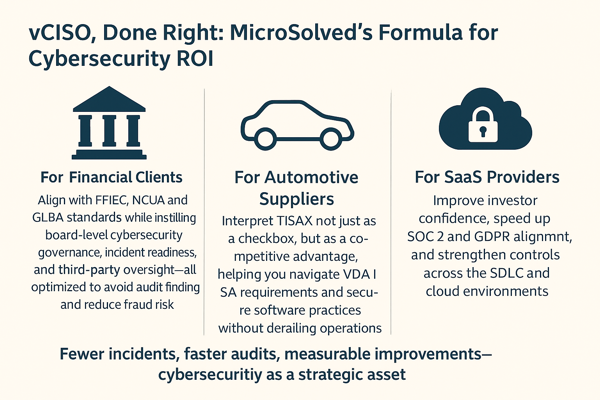
 

Unlock Top-Tier Cybersecurity Expertise with a Virtual CISO: The Smart Choice for Modern Businesses


In today’s rapidly evolving digital landscape, robust cybersecurity is no longer optional—it’s essential. However, hiring a full-time Chief Information Security Officer (CISO) can be financially out of reach for many organizations, especially small to medium-sized enterprises. That’s where a virtual CISO (vCISO) program comes in, offering a game-changing solution that brings world-class security leadership within reach of businesses of all sizes.

J0316739

Benefits

Let’s explore the key benefits of partnering with a vCISO:

  1. Access to Unparalleled Expertise: A vCISO brings a wealth of knowledge and experience gained from tackling diverse cybersecurity challenges across multiple industries. This broad perspective enables them to navigate complex security landscapes, anticipate emerging threats, and ensure your organization stays ahead of the curve.
  2. Cost-Effective Security Leadership: By opting for a vCISO, you gain access to top-tier security expertise without the substantial overhead of a full-time executive position. This flexibility allows you to allocate your budget more efficiently while still benefiting from strategic security guidance.
  3. Tailored Strategic Direction: Your vCISO will work closely with your team to develop and implement a comprehensive information security strategy aligned with your specific business objectives. They ensure your cybersecurity initiatives are not just robust, but also support your overall business goals.
  4. Scalability and Flexibility: As your business evolves, so do your security needs. A vCISO service model offers the flexibility to scale services up or down, allowing you to adapt quickly to new challenges, regulatory requirements, or changes in your business environment.
  5. Objective, Independent Insights: Free from internal politics and biases, a vCISO provides an unbiased assessment of your security posture. This independent perspective is crucial for identifying vulnerabilities and recommending effective risk mitigation strategies.
  6. Compliance and Best Practices: Stay on top of ever-changing regulatory requirements with a vCISO who understands the intricacies of compliance across various industries and regions. They’ll ensure your security practices not only meet but exceed industry standards.
  7. Knowledge Transfer and Team Empowerment: A key aspect of the vCISO role is mentoring your existing team. By transferring knowledge and best practices, they help grow your internal capabilities, boosting your team’s skills, confidence, and overall effectiveness.
  8. Continuous Improvement: The cybersecurity landscape never stands still, and neither should your security posture. A vCISO continually adjusts your security initiatives to address emerging threats, changing business needs, and evolving global regulations.

Conclusion

Don’t let cybersecurity challenges hold your business back. Embrace the power of a virtual CISO program and take your organization’s security to the next level.

Ready to revolutionize your cybersecurity strategy? The time to act is now.

More Information

Contact MicroSolved today for a no-pressure discussion about how our vCISO program can transform your security posture. With flexible engagement options tailored to your needs, there’s never been a better time to invest in your organization’s digital future.

Call us at 614-351-1237 or email info@microsolved.com to schedule your consultation. Don’t wait for a security breach to realize the importance of expert guidance—secure your business today with MicroSolved’s vCISO program.


* AI tools were used as a research assistant for this content.