3 Things You Should Be Reading About

Just a quick post today to point to 3 things infosec pros should be watching from the last few days. While there will be a lot of news coming out of Derbycon, keep your eyes on these issues too:

1. Chinese PLA Hacking Unit with a SE Asia Focus Emerges – This is an excellent article about a new focused hacking unit that has emerged from shared threat intelligence. 

2. Free Tool to Hunt Down SYNful Knock – If you aren’t aware of the issues in Cisco Routers, check out the SYNful Knock details here. This has already been widely observed in the wild.

3. Microsoft Revokes Leaked D-Link Certs – This is what happens when certificates get leaked into the public. Very dangerous situation, since it could allow signing of malicious code/firmware, etc.

Happy reading! 

Podcast Episode 8 is Out

This time around we riff on Ashley Madison (minus the morals of the site), online privacy, OPSec and the younger generation with @AdamJLuck. Following that, is a short with John Davis. Check it out and let us know your thoughts via Twitter – @lbhuston. Thanks for listening! 

You can listen below:

IoT Privacy Concerns

Lately, I’ve been amazed at how quickly the Internet of Things (IoT) has become a part of my life. Everything from speakers to a Crock-Pot (yes, a Crock-Pot) has been connected to my home wireless network at some point. As much as I enjoy all the conveniences that these devices provide me, I always consider the security implications prior to purchasing an Internet-connected device. It’s worthwhile to weigh the convenience of installing new Internet-connected equipment vs. the privacy issues that can occur if the device is compromised.

There have already been a variety of security issues stemming from the widespread adoption of IoT devices. Last fall, a website published links to over 73,000 unsecured camera throughout the world. These cameras monitored everything from shopping malls to people’s bedrooms. Without implementing proper controls around IoT devices, we will continue to see similar issues arise.

I don’t intend for this blog to scare people away from purchasing IoT devices. In fact, I will provide you with a few simple changes you can make to your IoT configurations that will reduce the privacy issues that can occur by installing an IoT system. These changes won’t necessarily diminish the conveniences you can gain by buying an Internet-connected thermostat or installing the latest IoT security camera. However, they will significantly reduce the risk associated with installing an IoT system.

A few recommendations for your new gadget:

  • Change the default password  – A majority of the aforementioned cameras were compromised because the owners did not change the system’s default password. By simply setting the password to something that will be difficult for an attacker to guess, you can reduce the risk of someone compromising your device.
  • Segment – Try to isolate your IoT devices from the rest of your home network. It is very possible that an attacker would use an IoT system as an entry-point to gain access to other systems.
  • Check for software updates – Make a routine to check for software/firmware updates for all of your IoT devices. These updates will often contain a security patch that can protect your system from being exploited.
  • Do not expose the device directly to the Internet – There shouldn’t be a need to expose an IoT device directly to the Internet. This will provide an attacker a much larger surface to attempt to exploit your device. If the system requires that configuration, it is worthwhile to consider another option.

DOJ Best Practices for Breach Response

I stumbled on this great release from the US Department of Justice – a best practices guide to breach response.

Reading it is rather reminiscent of much of what we said in the 80/20 Rule of Information Security years ago. Namely, know your own environment, data flows, trusts and what data matters. Combine that with having a plan, beforehand, and some practice – and you at least get some decent insights into what your team needs and is capable of handling. Knowing those boundaries and when to ask for outside help will take you a long way.

I would also suggest you give our State of Security Podcast a listen. Episode 6, in particular, includes a great conversation about handling major breaches and the long term impacts on teams, careers and lives.

As always, if we can assist you in preparing a breach response process, good policies, performing those network mappings or running table top exercises (or deeper technical red team exercises), let us know. We help companies around the world master these skills and we have plenty of insights we would love to share!

Are you hacking!? There’s no hacking in baseball!

My Dad called me earlier this week to ask if I heard about the FBI’s investigation of the St. Louis Cardinals. My initial reaction was that the investigation must be related to some sort of steroid scandal or gambling allegations. I was wrong. The Cardinals are being investigated for allegedly hacking into the network of a rival team to steal confidential information. Could the same team that my Grandparents took me to see play as a kid really be responsible for this crime?

After I had time to read a few articles about the alleged hack, I called my Dad back. He immediately asked me if the Astros could have prevented it. From what I have read, this issue could have been prevented (or at least detected) by implementing a few basic information security controls around the Astros’ proprietary application. Unfortunately, it appears the attack was not discovered until confidential information was leaked onto a pastebin site.

The aforementioned controls include but are not limited to:

  1. Change passwords on a regular basis – It has been alleged that Astros system was accessed by using the same password that was used when a similar system was deployed within the St. Louis Cardinals’ network. Passwords should be changed on a regular basis.
  2. Do not share passwords between individuals – Despite the fact that creating separate usernames and passwords for each individual with access to a system can be inconvenient, it reduces a lot of risk associated with deploying an application. For example, if each member of the Astros front office was required to have a separate password to their proprietary application, the Cardinals staff would not have been able to successfully use the legacy password from when the application was deployed in St. Louis. The Astros would also have gained the ability to log and track each individual user’s actions within the application.
  3. Review logs for anomalies on a regular basis – Most likely, the Astros were not reviewing any kind of security logs surrounding this application. If they were, they might have noticed failed login attempts into the application prior to the Cardinals’ alleged successful attempt. They also might have noticed that the application was accessed by an unknown or suspicious IP address.
  4. Leverage the use of honeypot technology – By implementing HoneyPot technology, the Astros could have deployed a fake version of this application. This could have allowed them to detect suspicious activity from within their network prior to the attackers gaining access to their confidential information. This strategy could have included leveraging MSI’s HoneyPoint Security Server to stand up a fake version of their proprietary application along with deploying a variety of fake documents within the Astros’ network. If an attacker accessed the fake application or document, the Astros would have been provided with actionable intelligence which could have allowed them to prevent the breach of one of their critical systems.
  5. Do not expose unnecessary applications or services to the internet – At this point, I do not know whether or not the Astros deployed this system within their internal network or exposed it to the internet. Either way, it’s always important to consider whether or not it is necessary to expose a system or service to the internet. Something as simple as requiring a VPN to access an application can go a long way to securing the confidential data.
  6. Leverage the use of network segmentation or IP address filtering – If the application was deployed from within the Astros internal network, was it necessary that all internal systems had access to the application? It’s always worthwhile to limit network access to a particular system or network segment as much as possible.

Honestly, I hope these allegations aren’t true. I have fond memories of watching the Cardinals win the World Series in 2006 and 2011. I would really hate to see those victories tarnished by the actions of a few individuals. However, it’s important that we all learn a lesson from this..whether it’s your email or favorite team’s playbook…don’t overlook the basic steps when attempting to secure confidential information.

State of Security Podcast Episode 5 Available

This is one of my favorite episodes so far! I spend about 45 minutes with Josh Anderson, who riffs on IT and ICS/SCADA security threats, career advice, how he compares his life to characters on TV’s “24” and a whole lot more. Very relaxed, generous in time and content, this interview with one of America’s Premier ICS Security Gurus (I just gave him that title…) is fun and lively. 

Special shout out to Kent King for his mentorship in this episode, as well. 
 
Let us know what you think Twitter. Thanks for listening! 

Involved in M&A Activity? MSI has a full M&A Practice


MSI’s specialized offerings around Mergers & Acquisitions are designed to augment other business practices that are common in this phase of business. In addition to general security consulting and intelligence about a company from a “hacker’s eye view”, we also offer deeply integrated, methodology-driven processes around:

  1. Pre-negotiation intelligence
    1. This offering is designed to help the purchasing organization do recon on their prospect for purchase. Leveraging techniques like passive assessment, restricted individual tracing, supply chain analysis, key stakeholder profiling and history of compromise research, the potential purchasing company can get deep insights into the security posture and intellectual property integrity of the company they are considering for acquisition. All of this can be done passively and prior to a purchasing approach or offer. Insights from this service can be a useful tool in assessing approach and potential valuation. 
  2. Pre-integration assessments 
    1. Once the ink on the paperwork is dry, the organizations have to learn to live and work together. One of the most critical links, is the joining of the two IT infrastructures. In this service, our experts can perform assessments to analyze the new company’s security posture against the baseline standards of the purchasing organization. A gap analysis and road map for compliance can be provided, and if desired, MSI can serve as oversight for ensuring that the mitigations are completed as a condition for network interconnection and integration. Our team has performed these services across a variety of M&A completions, including multi-national and global Fortune 500 organizations.
  3. Post-purchase threat intelligence 
    1. MSI can also create mechanisms post-purchase to identify and respond to potential threats from inside the newly acquired organization. Our counter-intelligence and operational security techniques can help organizations identify potential internal bad actors or disgruntled new employees that could be seeking to damage the acquirer. We have created these solutions across a myriad of verticals and are quite capable of working in international and other highly complex environments. 

To learn more about these specific offerings, click on the links above. To discuss these offerings in more detail, please contact your account executive for a free consultation.

Plus, we also just added some new capabilities for asset discovery, network mapping and traffic baselining. Check this out for some amazing new ways we can help you!

Operation Hardened Buckeye

MSI is pleased to announce the immediate formation and availability of Operation Hardened Buckeye!

This special program is dedicated to assisting Ohio’s Rural Electrical Cooperatives.

MSI will set up aggregated groups of Electrical Cooperatives and perform services and offer tools to the groups en-masse at discounted rates, as if they were one large company. Essentially, this allows the co-ops to leverage group buying, while still receiving individual reports, software licenses and overall group-level intelligence & metrics.

MSI will offer a package consisting of the following:

  • External Vulnerability Assessment with aggregated executive level reports/metrics & individual technical detail reports
  • An aggregated Targeted Threat Intelligence engagement with individual notifications of critical findings and an aggregated intelligence report for the group
  • 3 HoneyPoint Agent licenses and a console license per co-op that participates
  • Deep discounts to individual co-ops who desire application assessment, internal vulnerability assessments, wireless assessments or other MSI professional services (including MSI::Vigilance & ICS Network Segregation Services)
  • Deep discounts for ongoing assessments and targeted threat intelligence as a service

Caveats: All assessments will be performed at the same time. Co-ops must each sign onto a common MSA. Each co-op will be billed for the total of the package divided by the number of participating co-ops. Co-ops must provide accurate IP address ranges for their external assessment.

This enables the co-ops to have a security baseline of their security posture performed, including aligning their current status against that of their peers. It also allows for each of the co-ops to deploy a HoneyPoint Agent in their DMZ, business network and control network for detection capabilities. The targeted threat intelligence will provide them with an overall threat assessment, as well as identifying individual targets that have either already been attacked or are likely to provide easy/attention raising targets for future attacks.

We will be holding a webinar for those interested in participating on Thursday, May 21, 2015. You can register for this event here. You can also download the flyer about the program here.

For more information, please contact Allan Bergen via the email below or call (513) 300-0194 today! 

Email: sales@microsolved.com

First Step After Breach

Discovering an information security breach can be a shock! Picture it: you are enjoying a regular work day and WHAM! Suddenly you are at the center of an incident that could possibly affect the future of the company and perhaps your own future as well. It’s easy to panic. You know if you don’t do the right thing, right now, bad things are sure to rain down on you. So, what is the very first thing that you should do?

Go immediately to your incident response plan, of course! After all, that is the reason your company has put together an IR plan and team in the first place; to plan for contingencies so that personnel don’t go off half-cocked and lose vital data and evidence. 

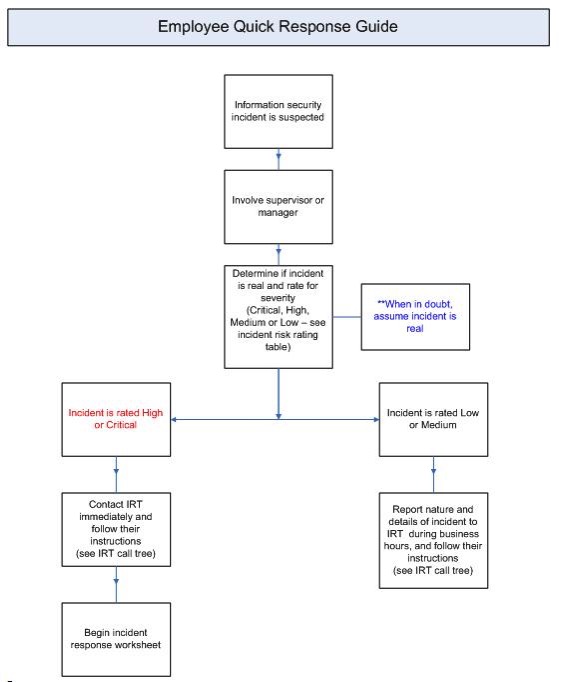
But is your plan clear enough that regular system users or even help desk personnel know what to do first without having to thumb through a hundred pages of plan? If not, perhaps a simple little trick we use in our incident response plans will work for you. 

The very first thing you see when you open one of our incident response plans are employee and incident response team Quick Response Guides (see the example of an employee guide below-the IRT guide is similar, but more complex). 

I know from my military experience that having checklists such as the Quick Response Guides in place truly cuts down on mistakes and helps calm personnel during difficult situations. Why not see if they can also improve your response quality?


Chart


You can download the pocket guide here. 

Thanks to John Davis for this post.

How to Use Risk Assessment to Secure Your Own Home

Risk assessment and treatment is something we all do, consciously or unconsciously, every day. For example, when you look out the window in the morning before you leave for work, see the sky is gray and decide to take your umbrella with you, you have just assessed and treated the risk of getting wet in the rain. In effect, you have identified a threat (rain) and a vulnerability (you are subject to getting wet), you have analyzed the possibility of occurrence (likely) and the impact of threat realization (having to sit soggy at your desk), and you have decided to treat that risk (taking your umbrella) – risk assessment.

However, this kind of risk assessment is what is called “ad hoc”. All of the analysis and decision making you just made was informal and done on the fly. Pertinent information wasn’t gathered and factored in, other consequences such as the bother of carrying the umbrella around wasn’t properly considered, other treatment options weren’t considered, etc. What business concerns and government agencies have learned from long experience is that if you investigate, write down and consider such factors rationally and holistically, you end up with a more realistic idea of what you are really letting yourself in for, and therefore you are making better risk decisions – formal risk assessment.

So why not apply this more formal risk assessment technique to important matters in your own life such as securing your home? It’s not really difficult, but you do have to know how to go about it. Here are the steps:

1. System characterization: For home security, the system you are considering is your house, its contents, the people who live there, the activities that take place there, etc. Although, you know these things intimately it never hurts to write them down. Something about viewing information on the written page helps clarify it in our minds.

  1. Threat identification: In this step you imagine all the things that could threaten the security of your home and family. These would be such things as fire, bad weather, intruders, broken pipes, etc. For this (and other steps in the process), you can go beyond your own experience and see what threats other people have identified (i.e. google inquiries, insurance publications).

  2. Vulnerability identification: This is where you pair up the threats you have just identified with weaknesses in your home and its use. For example, perhaps your house is located on low ground that is subject to flooding, or you live in a neighborhood where burglaries may occur, or you have old ungrounded electrical wiring that may short and cause a fire. These are all vulnerabilities.

  3. Controls analysis: Controls analysis is simply listing the security mechanisms you already have in place. For example, security controls used around your home would be such things as locks on the doors and windows, alarm systems, motion-detecting lighting, etc.

  4. Likelihood determination: In this step you decide how likely it is that the threat/vulnerability will actually occur. There are really two ways you can make this determination. One is to make your best guess based on knowledge and experience (qualitative judgement). The second is to do some research and calculation and try to come up with actual percentage numbers (quantitative judgement). For home purposes I definitely recommend qualitative judgement. You can simply rate the likelihood of occurrence as high, medium or low risk.

  5. Impact analysis: In this step you decide what the consequences of threat/vulnerability realization will be. As with likelihood determination, this can be judged quantitatively or qualitatively, but for home purposes I recommend looking at worst-case scenarios. For example, if someone broke into your home, it could result in something as low impact as minor theft or vandalism, or it could result in very high impact such as serious injury or death. You should keep these more dire extremes in mind when you decide how you are going to treat the risks you find.

  1. Risk determination: Risk is determined by factoring in how likely threat/vulnerability realizations is with the magnitude of the impact that could occur and the effectiveness of the controls you already have in place. For example you could rate the possibility of home invasion occurring as low, and the impact of the occurrence as high. This would make your initial risk rating a medium. Then you factor in the fact that you have an alarm system and un- pickable door locks in place, which would lower your final risk rating to low. That final rating is known as residual risk.

  2. Risk treatment: That’s it! Once you have determined the level of residual risk, it is time to decide how to proceed from there. Is the risk of home invasion low enough that you think you don’t need to apply any other controls? That is called accepting risk. Is the risk high enough that you feel you need to add more security controls to bring it down? That is called risk limitation or remediation. Do you think that the overall risk of home invasion is just so great that you have to move away? That is called risk avoidance. Do you not want to treat the risk yourself at all, and so you get extra insurance and hire a security company? That is called risk transference.

So, next time you have to make a serious decision in your life such as changing jobs or buying a new house, why not apply the risk assessment process? It will allow you to make a more rational and informed decision, and you will have the comfort of knowing you did your best in making the decision. 

Thanks to John Davis for this post.