
Three Things That Need Spring Cleaning in InfoSec

Spring is here in the US, and that brings with it the need to do some spring cleaning. So, here are some ideas of some things I would like to see the infosec community clean out with the fresh spring air!

1. The white male majority in infosec. Yes, I am a white male, also middle aged…. But, seriously, infosec needs more brains with differing views and perspectives. We need a mix of conservative, liberal and radical thought. We need different nationalities and cultures. We need both sexes in equity. We need balance and a more organic talent pool to draw from. Let’s get more people involved, and open our hearts and minds to alternatives. We will benefit from the new approaches!

2. The echo chamber. It needs some fresh air. There are a lot of dropped ideas and poor choices laying around in there, so let’s sweep that out and start again. I believe echo chamber effects are unavoidable in small focused groups, but honestly, can’t we set aside our self-referential shouting, inside jokes, rock star egos and hubris for just one day? Can’t we open a window and sweep some of the aged and now decomposing junk outside. Then, maybe, we can start again with some fresh ideas and return to loving/hating each other in the same breath. As a stop gap, I am nominating May 1, a Friday this year, as Global Infosec Folks Talk to Someone You Don’t Already Know Day (GIFTTSYDAKD). On this day, ignore your peers in the echo chamber on social media and actually go out and talk to some non-security people who don’t have any idea what you do for a living. Take them to lunch. Discuss their lives, what they do when they aren’t working, how security and technology impacts their day to day. Just for one day, drop out of the echo chamber, celebrate GIFTTSYDAKD, and see what happens. If you don’t like it, the echo chamber can come back online with a little fresh air on May 2 at 12:01 AM EST. How’s that? Deal? 🙂

3. The focus on compliance over threats. Everyone knows in their hearts that this is wrong. It just feels good. We all want a gold star, a good report card or a measuring stick to say when we got to the goal. The problem is, crime is an organic thing. Organic, natural things don’t really follow policy, don’t stick to the script and don’t usually care about your gold star. Compliant organizations get pwned  – A LOT (read the news). Let’s spring clean the idea of compliance. Let’s get back to the rational idea that compliance is the starting point. It is the level of mutually assured minimal controls, then you have to build on top of it, holistically and completely custom to your environment. You have to tune, tweak, experiment, fail, succeed, re-vamp and continually invest in your security posture. FOREVER. There is no “end game”. There is no “Done!”. The next “bad thing” that visits the world will be either entirely new, or a new variant, and it will be capable of subverting some subset or an entire set of controls. That means new controls. Lather, rinse, repeat… That’s how life works.. To think otherwise is irrational and likely dangerous.

That’s it. That’s my spring cleaning list for infosec. What do you want to see changed around the infosec world? Drop me a line on Twitter (@lbhuston) and let me know your thoughts. Thanks for reading, and I hope you have a safe, joyous and completely empowered Spring season!
MSI Launches TigerTrax Network Discovery, Mapping & Analysis Service

We are proud to announce the immediate availability of an entirely new service offering in our security tool kit, made possible by TigerTrax™.

This service offering leverages the power of MSI’s proprietary TigerTrax analytics platform to parse, correlate and visualize the configurations (and packet logs (if desired)) from the routers, switches and firewalls of your network “en masse”. 

Our security and analytics teams then create detailed maps of the network as seen from the eyes of the machines, document the various network segments and their relationships, build a hierarchy of powerful machines and segments, identify hardening techniques that could help your organization better secure your network and provide insights into the gap between your organization’s “common wisdom” versus the real environment.

We can even teach “Close The Gap” sessions to help re-align your team’s “common wisdom” with “machine truth” and to help socialize the new knowledge to other groups.

How it works:

  • The client delivers the configuration and log files as needed for the service. MSI can assist with this step, if needed, at an additional hourly consulting fee.
  • The offering uses TigerTrax to perform automated analysis of the configuration and log files as needed – holistically, systemically and “en masse”. 
  • Various data points are delivered to the analysts and security team who then create the documentation, maps and reports. Visualized data is also generated using the TigerTrax platform where appropriate.
  • Any professional services, such as interviews/questionnaires, gap analysis and training are provided by MSI team members using our proprietary delivery methodologies.
  • Completely passive, offline analysis is perfect for critical networks.
Three different levels of service are available, as is single – one time engagements (perfect for M&A activities, and new IT management) or ongoing subscriptions that allow organizations to track changes and maintain knowledge over time. The highest level of service also includes 30 days worth of packet analytics to identify overtly compromised hosts and to determine “normal operating conditions”, which is often quite useful for incident response activities in the future.
 
Give is a call today at (614) 351-1237 or email us at info@microsolved.com to start a conversation about how we can help you know the truth about your network!

State Of Security Podcast Episode 3 is Now Available

Episode 3 of the podcast is now available!

In this edition, I sit down with Bill @Sempf to discuss application security, working with development teams and how to get security and dev folks on the same page. Bill goes so far as to recommend a simple 2 step process that you simply have to hear!

Check it out:

And give us feedback on Twitter (@lbhuston) about this and all other episodes or ideas you have about what you would like us to cover. Thanks for listening!  

How to Make InfoSec Infographics

Infographics are everywhere! And people either love them or hate them.

That said, many security teams have been asking about building infographics for awareness or communicating threat data to upper management in quick easily-digestible bites. To help with that, we thought we would tell you what we have learned about how to make infographics – as a best practice – so you won’t have to suffer through the mistakes we and others in the security field have already made. 🙂

So, at a high level, here is what you need to know about making infographics on security topics:

What are infographics & why are they useful?

Infographics are a visual representation of data and information; it is a quick way to look at a lot of in-depth information and get a clear understanding of it. They are used to communicate data in a way that is compact and easy to comprehend and also provide an easy view of cause and effect relationships. Infographics are visually appealing and are composed of three elements:
– visual (color, graphics, reference icons)
– content (time frame, statistics, references)
– knowledge (facts)

Best practices for building infographics: 

– Simplicity: clean design that is compact and concise with well organized information
– Layout: Maximum of 3 different fonts
– Colors: choose colors that match the emotions you are trying to convey. The background should blend with the illustrations
– Boundaries: limit the scope of your information. Attention span is short so try to answer only one question per infographic

The main best practice we have learned is: Keep It Simple! Focus on just a few salient points and present them in interesting tidbits. Use templates, they are available all over the web for your publishing or office platform. Remember, the purpose of infographics is to peak interest in a discussion, not serve as the end-all, be-all of presenting data to the audience.

Let us know your success stories or tell us what you have learned about infographics on Twitter (@lbhuston or @microsolved). Thanks for reading!

Hiring Data Analysts Who Love Security

MSI is growing again! We are interested in talking to folks about a full time position in our Columbus HQ to help our Intelligence Team.

If you dig being heads down with data, performing deep research and chasing threats around the Internet, this is the gig for you! These folks will be focused primarily on threat profiling, research of companies, crime rings and security news from around the world. The job requires you be familiar with Linux,  have an understanding of information security and to be a power user of the Internet. You should also enjoy python, BASH scripting, command line kung fu and staying bleeding edge current on security happenings. Light public speaking on webinars and conference calls, familiarity with the Mac and excellent writing skills are also preferred.

MSI is an interesting place to work. Our team is seriously dedicated to helping our clients. We are known for doing excellent work, thinking outside the box, going deep into a problem and laser focusing on customer success. Our conversations among team members are fast and full of high density data exchange. It is exciting, fulfilling and demanding work, but we do it with joy, precision and mindful innovation!

Sound like something you might enjoy? If so, get in touch. Send your resume and a cover letter that explains why you are the best choice for our team to info@microsolved.com. You can also touch base with me on Twitter if you have questions (@lbhuston). We hope to hear from you if you truly love deep diving on data and hammering out the truth from content all around the web!

PS – Don’t worry, we know we have to train you. We are looking for people with strong core skills, an eagerness to learn and out of the box thinking. We’ll teach you the rest… 🙂

Malware Can Hide in a LOT of Places

This article about research showing how malware could be hidden in Blu-Ray disks should serve as a reminder to us all that a lot of those “smart” and “Internet-enabled” devices we are buying can also be a risk to our information. In the past, malware has used digital picture frames, vendor disks & CD’s, USB keys, smart “dongles” and a wide variety of other things that can plug into a computer or network as a transmission medium.

As the so called, Internet of Things (IoT), continues to grow in both substance and hype, more and more of these devices will be prevalent across homes and businesses everywhere. In a recent neighbor visit, I enumerated (with permission), more than 30 different computers, phones, tablets, smart TV’s and other miscellaneous devices on their home network. This family of 5 has smart radios, smart TVs and even a Wifi-connected set of toys that their kids play with. That’s a LOT of places for malware to hide…

I hope all of us can take a few minutes and just give that some thought. I am sure few of us really have a plan that includes such objects. Most families are lucky if they have a firewall and AV on all of their systems. Let alone a plan for “smart devices” and other network gook.

How will you handle this? What plans are you making? Ping us on Twitter (@lbhuston or @microsolved) and let us know your thoughts.

Podcast Episode 2 is Now Available

In this episode we sit down with Mark Tomallo, from Panopticon Labs, and RSA’s Kevin Flanagan. We discuss mentoring, online crime, choosing infosec as a career and even dig out some tidbits from Mark about online gaming fraud and some of the criminal underground around the gaming industry. I think this is a very interesting and fun episode, so check it out and let us know what you think on Twitter (@microsolved, or @lbhuston). Thanks for listening! 

Listen Here:

Keep Your Hands Off My SSL Traffic

Hey, you, get off my digital lawn and put down my binary flamingos!!!!! 

If you have been living under an online rock these last couple of weeks, then you might have missed all of the news and hype about the threats to your SSL traffic. It seems that some folks, like Lenovo and Comodo, for example, have been caught with their hands in your cookie jar. (or at least your certificate jar, but cookie jars seem like more of a thing…) 

First, we had Superfish, then PrivDog. Now researchers are saying that more and more examples of that same code being used are starting to emerge across a plethora of products and software tools.

That’s a LOT of people, organizations and applications playing with my (and your) SSL traffic. What is an aging infosec curmudgeon to do except take to the Twitters to complain? 🙂

There’s a lot of advice out there, and if you are one of the folks impacted by Superfish and/or PrivDog directly, it is likely a good time to go fix that stuff. It also might be worth keeping an eye on for a while and cleaning up any of the other applications that are starting to be outed for the same bad behaviors.

In the meantime, if you are a privacy or compliance person for a living, feel free to drop us a line on Twitter (@lbhuston, @microsolved) and let us know what your organization is doing about these issues. How is the idea of prevalent man-in-the-middle attacks against your compliance-focused data and applications sitting with your security team? You got this, right? 🙂

As always, thanks for reading, and we look forward to hearing more about your thoughts on the impacts of SSL tampering on Twitter! 

Podcast Episode 1 is Now Available

This episode is about 45 minutes in length and features an interview with Dave Rose (@drose0120) and Helen Patton (@OSUCISOHelen) about ethics in security, women in STEM roles and career advice for young folks considering Infosec as a career. Have feedback, let me know via Twitter (@lbhuston).

 
As always, thanks for listening and reading stateofsecurity.com!
 
Listen here: 
 
PS – We decided to restart the episode numbers, move to pod bean.com as a hosting company and make the podcast available through iTunes. We felt all of those changes, plus the informal date-based episode titles we were using before made the change a good idea.

Recently Observed Attacks By Compromised QNAP Devices

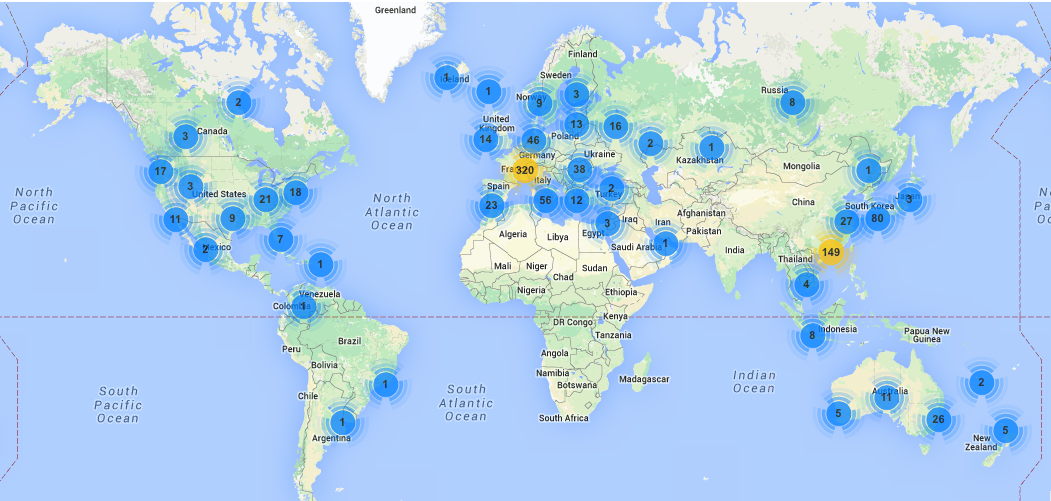
Despite the fact that the Shellshock bug was disclosed last fall, it appears that a wide variety of systems are still falling victim to the exploit.  For example, in the last 30 days, our HoneyPoint Internet Threat Monitoring Environment has observed attacks from almost 1,000 compromised QNAP devices.  If you have QNAP devices deployed, please be sure to check for the indicators of a compromised system.  If your device has not been affected, be sure to patch it immediately.

Once compromised via the Shellshock bug, the QNAP system downloads a payload that contains a shell script designed specifically for QNAP devices.  The script acts as a dropper and downloads additional malicious components prior to installing the worm and making a variety of changes to the system.  These changes include: adding a user account, changing the device’s DNS server to 8.8.8.8, creating an SSH server on port 26 and downloading/installing a patch from QNAP against the Shellshock bug.

The map below shows the locations of compromised QNAP systems that we observed to be scanning for other unpatched QNAP systems.  If you have any questions regarding this exploit, feel free to contact us by emailing info <at> microsolved.com.

Screen Shot 2015-01-27 at 1.41.31 PM