What Is A Trust Map?

For about a year now we have been getting questions from folks about basic trust maps, what they are and how they are used. After answering several times person to person, we thought it might be time for a simple blog post to refer folks to.

The purpose of a trust map is to graphically demonstrate trust between components of your organization or business process. It is a graphic map of how authentication occurs, what systems share accounts and what systems trust what other systems in an environment.

Trust maps are very useful for explaining your organization to new IT folks, helping auditors understand your authentication and security models, and especially for using as reference in incident response. Done properly, they become a powerful tool with a real payoff. For example, when an attack occurs and some mechanism gets compromised in your environment, you can use your trust map to quickly examine how to isolate the affected portions of the authentication model and learn what additional systems the attacker may have been able to trivially leverage given the access they gained. It really makes incident response much more effective and truly helps your teams respond to problems in a more intelligent and effective way.

It might take a little time to map complex organizations. If that proves to be a challenge, try starting with key business processes until you get to a point where you can create a holistic map with drill down process maps. This has proven to be an effective approach for larger/more complex organizations. If you need assistance with gathering the data or getting some additional political alliances to help the project along, our experience has been that the Disaster Recovery and Business Continuity folks usually have good starting data and are often easy to get engaged pushing the project through, especially since, in the long run, they get value from the maps too!

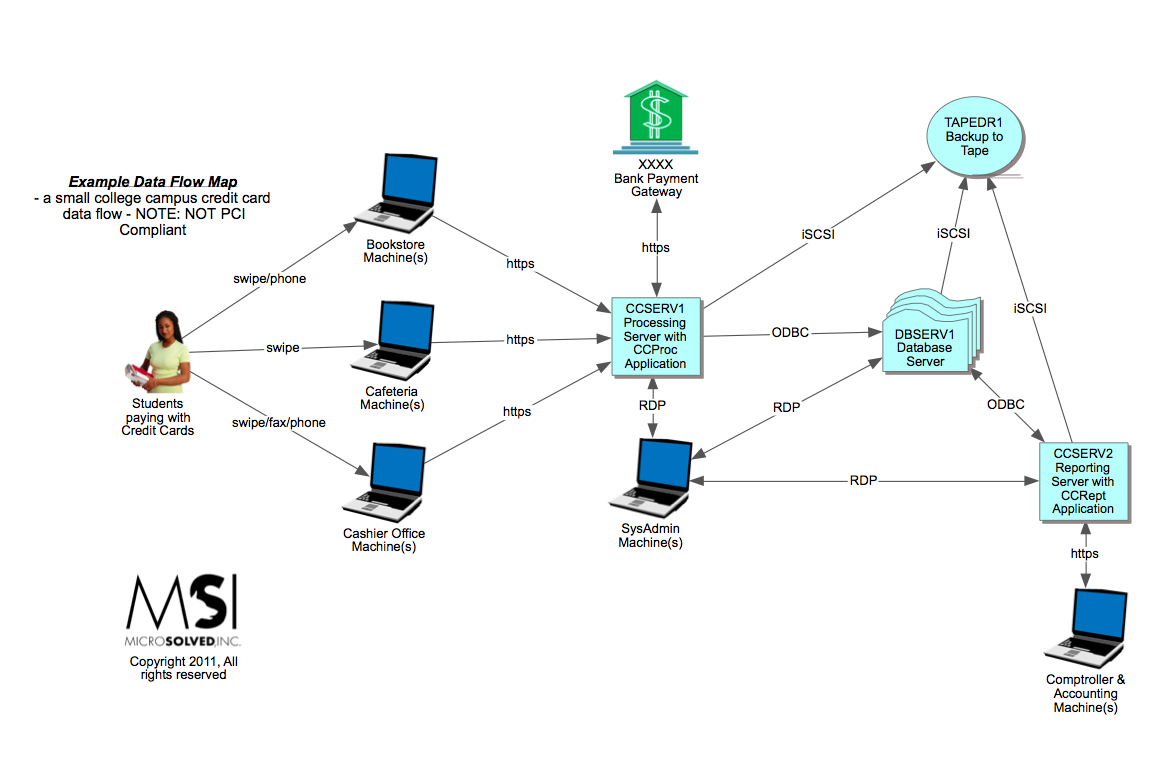
Here is an example map for you to use. It is pretty simple, but should give you the idea.

For more information or help creating your own trust maps, drop us a line or give us a call. We’d be happy to help or even get engaged to make the maps for you as a part of other security testing and projects. As always, thanks for reading and stay safe out there!

Audio Blog Post: Surface Mapping and Security

Brent Huston, CEO and Security Evangelist for MicroSolved, Inc. interviews Phil Grimes, Security Analyst.

Surface mapping is a highly useful strategy for evaluating a security environment. In this audio blog post, we talk about:

    • What Surface Mapping is
    • How MSI does it
    • Mobile platforms and the similarities and differences with testing them vs. other platforms
    • How to avoid becomeing complacent with your environment

Click here to listen for more!

MSI Strategy & Tactics Talk Episode 6: Fall-out From Anti-Sec and “Hactivism”

“The fall-out from these types of attacks are going to cause an undue amount of stress with new requirements.” – Brent Huston, CEO and Security Evangelist for MSI

Listen in as our tech team discusses the recent rash of “hactivism,” including:

  • What is a hacktivist?
  • How has hacktivism matured over the last several years?
  • What do you make of the anti-sec movement and the motives of groups like Anonymous, Lulzsec, etc.?
  • What do corporate security teams need to know about the antisec movement?
  • What is the likely fallout from all of the recent breaches and media attention to such attacks?

Panelists:

Brent Huston, CEO and Security Evangelist, MicroSolved, Inc.
Adam Hostetler, Network Engineer and Security Analyst
Phil Grimes, Security Analyst
John Davis, Risk Management Engineer
Mary Rose Maguire, Moderator, Marketing Communication Specialist, MicroSolved, Inc.

Click the embedded player to listen. Or click this link to access downloads. Stay safe!

Audio Blog Post: Interview With Teresa West, Project Manager

Brent Huston, CEO and Security Evangelist for MicroSolved, Inc. interviews Teresa West, MSI’s Project Manager.

Project Management is integral to MSI’s successful relationships with our clients. Some of the highlights include:

  • Tools for keeping clients up-to-date
  • How MSI uses customization to drive extreme flexibility
  • How MSI delivers exactly what the customer wants

Click here to listen for more!

MicroSolved’s Strategies & Tactics Talk: #3 APT: Less Advanced Than You May Think

So how “advanced” is APT?

Listen in as our tech team discusses various aspects of APT such as:

  • How it has been portrayed.
  • Why it often isn’t an advanced threat
  • Where do they originate?
  • What can companies do about APT?

Panelists:

Brent Huston, CEO and Security Evangelist, MicroSolved, Inc.
Adam Hostetler, Network Engineer and Security Analyst
Phil Grimes, Security Analyst
Mary Rose Maguire, Moderator, Marketing Communication Specialist, MicroSolved, Inc.

Click the embedded player to listen. Or click this link to access downloads. Stay safe!

MSI HoneyPoint Featured on Virtualization Security Podcast


Brent Huston, CEO and Security Evangelist of MicroSolved, Inc., was recently a guest for the popular podcast, “Virtualization Security Podcast.”

Brent talked about HoneyPoint Wasp and discussed with other panelists how honeypot technology can help an organization detect real attacks and also the legal ramifications of stealth monitoring.

The Virtualization Practice also featured HoneyPoint in their recent post, “New Virtualization Security Products Available.”

The podcast panelists include;

  • Edward L. Haletky, Author of VMware vSphere and Virtual Infrastructure Security: Securing the Virtual Environment and virtualization security analyst, as Moderator.
  • Michael Berman, CTO of Catbird Security
  • Iben Rodriguez, Independent Virtualization and Security Consultant and Maintainer of the ESX Hardening Guidance from CISecurity

Click on the player below to listen. To listen on iTunes or download the MP3, go here. Enjoy!

Powerless No More! Making Your Threat-Centric Penetration Testing Work for You


By now, even small organizations should know that they need periodic penetration testing focused on their critical processes if they hope to secure and protect their data. The question is, when this testing is being performed, are they getting something of value or just another checkbox on a compliance form? At MicroSolved, we believe in the first and we think you should get the latter naturally from the exercise. The problem is, the effort is NOT vice-versa.

Compliance-centric penetration testing is when the simulated attacker really takes the eye of an auditor. They focus only on testing the surfaces, elements and data sources absolutely required by the standard you are being tested against. These “penetration tests” are usually little more than a vulnerability scan and a run through by an engineer who “validates” that you are vulnerable. Little attention is paid to impact of compromise, how compromised systems and their information could be leveraged to get to the critical information or data and vulnerability chains (complex failures that cascade) are often ignored or completely unidentified. You can tell if the assessment is compliance-centric if the assessment doesn’t include items like testing multi-stage attacks, simulated malware and simulated social engineering failures. In many cases, for example, in the MicroSolved testing methodology, these attack surfaces are exercised, monitored, modeled and then regardless of outcome, emulated as if they failed during internal assessments to ensure reliable, real-world impacts are measured.

Threat-centric penetration testing, which by now, you probably know, is what MicroSolved is famous for. Our process doesn’t focus on compliance. It focuses on protecting your assets against the real world threats. We perform like an attacker, NOT like an auditor. We map attack surfaces, compare them to the real world, real-time data streams we get from the HoneyPoint Internet Threat Monitoring Environment (HITME) every day. We take our knowledge of what attackers do and how they work and apply it to your organization. We test the attack surfaces and note how they respond. We model what would happen if your controls succeed and what happens when they fail. Our testing takes a little while longer, and in some cases is a bit more expensive than the “scan and verify” providers, because our penetration team measures your systems against complex, multi-stage leveraged attacks just like you should expect from a real-world attacker targeting your data. We crack passwords, steal documents, social engineer your team, root through your electronic trash (and sometimes even the physical trash) and tear into your internal networks just as if we were a bot-herder, a malware author or a bad guy who got a job in customer service or the mailroom. We work with you to establish the scope and bounds of the exercise, but in the end, you get a real, true and holistic look at your defenses and the ways you can improve. You also get the capability to check that compliance box with the full knowledge and confidence that you tested not just their limited scope or with blinders on approach, but against a real-world, bleeding edge group of attackers focused on getting YOUR data.

At MicroSolved, we think that if you’re going to spend money on penetration testing, you should get what you pay for. You should get a real measurement against real threats and a real idea of what needs to be improved. If all you want is a checkbox, you can find plenty of folks to “scan and forget” with prices starting at FREE and ending at hundreds of thousands of dollars. Their cookie-cutter processes should let you check the box on your next set of forms, but maybe not sleep at night while you wonder if the data is really OK. On the other hand, working with a real-world emulating, threat-centric team, might cost a little more in the short run, but just of the money you’ll be saving in fines, legal fees and forensics costs for each attack vector mitigated in the event of a compromise. Give us a call. We’ll be happy to tell you more or work with you to set up a project to help you evaluate other penetration testing teams where MSI might not be a perfect fit.